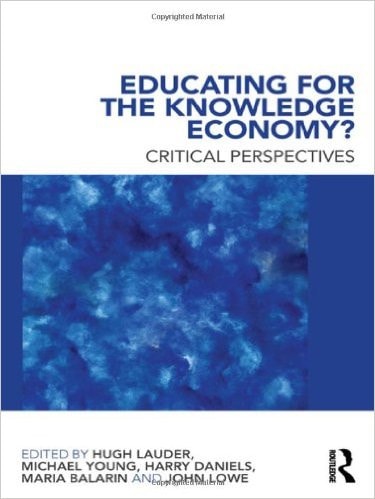
Educating for the Knowledge Economy?: Critical Perspectives
0
0
As an Amazon Associate and affiliate partner, Menrva Books earns from qualifying purchases. Learn more
Author Description
The promise, embraced by governments around the world, is that the knowledge economy will provide knowledge workers with a degree of autonomy and permission to think which enables them to be creative and to attract high incomes. What credence should we give to this promise? The current economic crisis is provoking a reappraisal of both economic and educational policy. Policy makers and educationists across the world see education as central to economic competitiveness. However, this book asks fundamental questions about the relationship between the economy and education since, in contrast to policy makers' rhetoric, the relationship between the two sectors is not straightforward. An unorthodox account of the knowledge economy and economic globalisation suggests that autonomy in the workplace and permission to think will be only given to the elite. In this view many aspirant well-educated middle-class young workers are doomed to disappointment. In this book, leading scholars from the US, the UK, Australia and New Zealand discuss these issues and interrogate the assumptions and links between the different elements of education and how they might relate to the economy. Even if we assume that the official view of the knowledge economy is correct are we educating young people to be autonomous, creative thinkers? Are current policies relating to knowledge, learning and assessment consistent with the kinds of workers and skills required for the knowledge economy? This book will appeal to academics, policy makers, teachers and students interested in the central role of education in the knowledge economy
Menrva's Summary
THE THESIS
This book investigates the validity of the 'knowledge economy' promise, questioning whether modern educational systems actually prepare workers for creative autonomy or merely reinforce existing social hierarchies. Author Hugh Lauder, alongside a cohort of international scholars, examines the disconnect between political rhetoric regarding economic competitiveness and the reality of labor market outcomes. The text challenges the assumption that increased education automatically leads to high-income, creative roles for the middle class. By analyzing global economic trends, the contributors argue that the benefits of the knowledge economy are likely restricted to a small elite, leaving many graduates with unmet expectations.
THE SCOPE MAP
What You Will Find
- Critical analysis of the relationship between educational policy and global economic structures.
- Comparative perspectives from scholars in the US, UK, Australia, and New Zealand.
- Examination of current pedagogical approaches to knowledge, learning, and assessment.
- Theoretical frameworks regarding workplace autonomy and the stratification of the labor market.
THE AUTHORITY PERSPECTIVE
Experts identify this work as a significant contribution to the sociology of education and political economy. Readers frequently note the academic density of the prose, which serves as a rigorous critique of contemporary neoliberal educational reforms.
Page Count:
264
Publication Date:
2012-01-01
Publisher:
Routledge
ISBN-10:
0203817699
ISBN-13:
9780203817698
Economics
Sociology
Globalization
Globalization and education
Educational Reform
Education
Public Policy
Training of
Community Tags
Similar Books