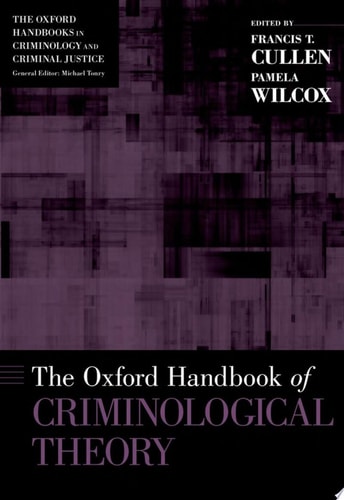
The Oxford Handbook of Criminological Theory
0
0
As an Amazon Associate and affiliate partner, Menrva Books earns from qualifying purchases. Learn more
Author Description
Criminological theory texts typically follow a conventional format. Diverse writings are neatly packaged into schools of thought, which are given clear labels and conveyed a chapter at a time, with topics like control theory in one chapter and strain theory in another.The Oxford Handbook of Criminological Theory takes a different approach across the criminological landscape. The volume is organized not around schools of thought but around themes that shape much thinking about and research on crime. This more unconventional approach seeks to show that criminological theory is not static but dynamic. In fact, most prominent scholars do not spend their time commenting upon and retesting theoretical propositions that have existed for many years. Rather, they move into more novel areas--areas often located in the interstitial junctures between more traditional theories. This Oxford Handbook presents a series of essays that captures not the past of criminology, but where theoretical explanation is headed. As a result, the volume is replete with new ideas, discussions of substantive topics with salient theoretical implications, and reviews and interpretations of literatures that illuminate promising avenues along which theory and research should evolve. Special attention is paid to how criminal participation is shaped intimately by individual traits, diverse social contexts, the situations in which the choice of crime is made, and exposure to coercive experiences. Each chapter can be read on its own--as furnishing an important analysis of a given theoretical issue--yet read as a whole, The Oxford Handbook of Criminological Theory offers a unique and deep understanding of criminology at its cutting edge.
Menrva's Summary
THE THESIS
This volume investigates the current trajectory of criminological theory by shifting the focus from static, traditional schools of thought to dynamic, thematic intersections that define contemporary research. Editors Francis T. Cullen and Pamela Wilcox, both established scholars in the field, curate a collection of essays that prioritize emerging theoretical developments over historical summaries. The text argues that the most significant advancements in the discipline occur at the boundaries of established theories, necessitating a thematic rather than categorical approach to understanding criminal behavior.
THE SCOPE MAP
What You Will Find
- Analysis of how individual traits and social contexts influence criminal participation.
- Exploration of situational choice and the impact of coercive experiences on behavior.
- Essays detailing the evolution of theoretical explanations in modern criminology.
Scope Limits
- The text does not provide a comprehensive historical survey of classical criminological schools.
- It does not serve as an introductory textbook for foundational theories but rather as an advanced exploration of current research frontiers.
THE AUTHORITY PERSPECTIVE
Experts recognize this volume as a significant departure from standard pedagogical formats, favoring a forward-looking perspective on the discipline. Readers frequently note the academic density of the prose, which is intended for graduate-level students and professional researchers in the social sciences.
Page Count:
756
Publication Date:
2015-12-01
Publisher:
Oxford University Press
ISBN-10:
0190457074
ISBN-13:
9780190457075
Sociology
Criminology
Social Science
Law
Community Tags
Other Editions(3)
Similar Books




Reader Comments
Share Your Thoughts
No comments yet. Be the first to share your thoughts!