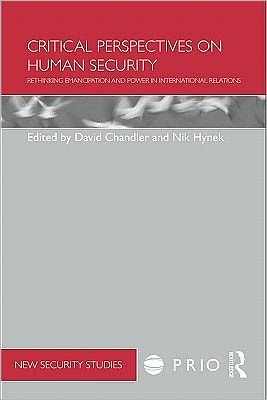
Critical Perspectives on Human Security: Rethinking Emancipation and Power in International Relations
0
0
As an Amazon Associate and affiliate partner, Menrva Books earns from qualifying purchases. Learn more
Author Description
This new book presents critical approaches towards Human Security, which has become one of the key areas for policy and academic debate within Security Studies and IR.The Human Security paradigm has had considerable significance for academics, policy-makers and practitioners. Under the rubric of Human Security, security policy practices seem to have transformed their goals and approaches, re-prioritising economic and social welfare issues?that were marginal to the state-based geo-political rivalries of the Cold War era. Human Security has reflected and reinforced the reconceptualisation of international security, both broadening and deepening it, and, in so doing, it has helped extend and shape the space within which security concerns inform international policy practices. However,?in its wider use, Human Security has become an amorphous and unclear political concept, seen by some?as progressive and radical and by others as?tainted by association with the imposition of neo-liberal practices and values on non-Western spaces?or as legitimizing attacks on Iraq and Afghanistan.This book is concerned with critical perspectives towards Human Security, highlighting some of the tensions which can emerge between critical perspectives which discursively radicalise Human Security within frameworks of emancipatory possibility and those which attempt to deconstruct Human Security within the framework of an externally imposed attempt to regulate and order the globe on behalf of hegemonic power. The chapters gathered in this edited collection represent a range of critical approaches which bring together alternative understandings of human security.This book will be of great interest to students of human security studies and critical security studies, war and conflict studies and international relations.
Menrva's Summary
THE THESIS
This book investigates the conceptual ambiguity of Human Security by examining the tension between its potential for emancipation and its role as a tool for hegemonic global regulation. Editors David Chandler and Nik Hynek compile a series of essays from various scholars to analyze how the Human Security paradigm has shifted from traditional state-based geopolitical concerns toward broader social and economic welfare issues. The text critically evaluates whether these policy shifts represent genuine progress or the imposition of neo-liberal values on non-Western regions.
THE SCOPE MAP
What You Will Find
- Analysis of the evolution of security policy from Cold War state-centrism to contemporary human-centric frameworks.
- Critical deconstruction of the political utility of Human Security in legitimizing international interventions.
- Comparative examination of emancipatory discourse versus regulatory power structures.
- Scholarly perspectives on the intersection of international relations, conflict studies, and global governance.
THE AUTHORITY PERSPECTIVE
Experts identify this collection as a significant contribution to critical security studies, noting its utility for advanced students and researchers in international relations. The prose is academically dense and provides a rigorous framework for those questioning the normative assumptions behind modern security policy.
Page Count:
216
Publication Date:
2010-01-01
Publisher:
Taylor & Francis Group
ISBN-10:
020384758X
ISBN-13:
9780203847589
Human rights
International relations
Security Studies
Sociology
Community Tags
Similar Books