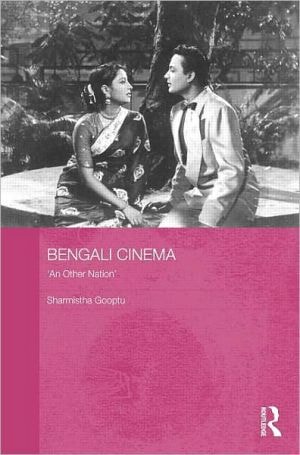
Bengali Cinema: 'An Other Nation'
0
0
As an Amazon Associate and affiliate partner, Menrva Books earns from qualifying purchases. Learn more
Author Description
Covering the years spanning cinema’s emergence as a popular form in Bengal in the first half of the twentieth century, this book examines the main genres and trends produced by this cinema, and leads up to Bengali cinema’s last phase of transition in the 1980s. Arguing that Bengali cinema has been a key economic and social institution, the author highlights that the Bengali filmic imaginary existed over and above the imaginary of the Indian nation.This book argues that a definitive history of Bengali cinema presents an alternative understanding to the currently influential notion of the Hindi film as the ‘Indian’ or ‘national’ cinema. It suggests that the Bengali cinema presents a history which brings to the fore the deeply contested terrain of ‘national’ cinema, and shows the creation of the ‘alternative imaginary’ of the Bengali film. The author indicates that the case of the Bengali cinema demonstrates the emergence of a public domain that set up a definitive discourse of difference with respect to the ‘all-India’ Hindi film, popularly classified as Bollywood cinema, and which pre-empted its subsumption within the more pervasive culture of the Bombay Hindi cinema. As the first comprehensive historical work on Bengali cinema, this book makes a significant contribution to both Film and Cultural Studies and South Asian Studies in general.
Menrva's Summary
THE THESIS
This book investigates whether the history of Bengali cinema offers a distinct alternative to the dominant narrative of Hindi-language Bollywood as the sole representative of Indian national cinema. Sharmistha Gooptu, an expert in South Asian film history, utilizes archival research and cultural analysis to argue that Bengali film established a unique public domain. By examining the economic and social institutions of the region, she demonstrates how this cinema maintained an independent imaginary that resisted total assimilation into the pervasive culture of Bombay-based film production.
THE SCOPE MAP
What You Will Find
- A historical survey of Bengali cinema from its early twentieth-century emergence through the 1980s transition period.
- An analytical framework comparing regional Bengali filmic identity against the national Hindi film paradigm.
- Primary source evidence detailing the economic and social development of the Bengali film industry.
- A critical examination of how regional cinema functions as a site of contested national identity.
THE AUTHORITY PERSPECTIVE
Scholars and film historians recognize this work as a foundational text for understanding the regional nuances of Indian cinema. Experts frequently highlight the book's academic rigor and its success in challenging the monolithic view of national film history.
Page Count:
248
Publication Date:
2010-01-01
Publisher:
Routledge
ISBN-10:
0203843347
ISBN-13:
9780203843345
History
Film Studies
Motion pictures
Cinema
Community Tags
Similar Books