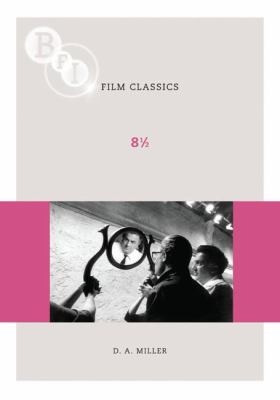
BFI Film Classics: 8 1/2
0
0
As an Amazon Associate and affiliate partner, Menrva Books earns from qualifying purchases. Learn more
Author Description
On its release in 1963, Federico Fellini's 8 1/2 shocked audiences around the world with its sheer auteurist gall. Whether attacked for self-indulgence or extolled for self-consciousness, 8 1/2 became the paradigm of personal film-making, and numerous directors, including Martin Scorsese, Woody Allen and Bruce LaBruce, paid homage to it in their own work. Now that 8 1/2's conceit is less shocking, D. A. Miller argues, we can see more clearly how tentative, even timid, Fellini's ground-breaking incarnation always was. Guido is a perfect blank, or is trying his best to seem one. By his own admission he doesn't even have an artistic or social statement to offer: 'I have nothing to say, but I want to say it anyway.' 8 1/2's deepest commitment is not to this man (who is never quite 'all there') or to his message (which is lacking entirely) but to its own flamboyant manner. The enduring timeliness of 8 1/2 lies, Miller suggests, in its aggressive shirking of the shame that falls on the man - and the artist - who fails his appointed social responsibilities. --Book Jacket.
Menrva's Summary
THE THESIS
This book examines Federico Fellini's seminal 1963 film, 8 1/2, challenging its initial reception as purely self-indulgent. D. A. Miller, a noted film critic, analyzes the film's enduring impact and its status as a paradigm of personal filmmaking. Miller argues that beyond the shock of its auteurist approach, the film's true strength lies in its exploration of artistic creation, self-consciousness, and the artist's struggle with societal expectations. The analysis delves into Guido's character, or lack thereof, and the film's commitment to its own stylistic flair over a concrete message.
THE SCOPE MAP
- Analysis of Federico Fellini's 1963 film, 8 1/2
- Exploration of the film's initial reception and its impact on personal filmmaking
- Examination of auteurist techniques and self-consciousness in cinema
- Discussion of Guido's character and his artistic/social statements
- Interpretation of the film's stylistic choices and thematic concerns
- Contextualization of the film's timeliness in relation to artistic responsibility and failure
- References to directors influenced by 8 1/2, such as Martin Scorsese and Woody Allen
THE AUTHORITY PERSPECTIVE
D. A. Miller's analysis of Fellini's 8 1/2 is presented as a critical re-evaluation of a film initially perceived as self-indulgent. The book suggests that by moving past the initial shock, viewers can appreciate the film's more subtle explorations of artistic process and societal pressures. Miller's argument focuses on the film's stylistic boldness and its engagement with the artist's potential failure to meet expectations. The work positions 8 1/2 not just as a personal statement, but as a commentary on the very act of creation and its inherent anxieties.
Page Count:
0
Publication Date:
2011-01-01
ISBN-10:
2952798346
ISBN-13:
9782952798341
Non-Fiction
History
Art
Film Studies
Cinema
Art History
Community Tags
Similar Books














