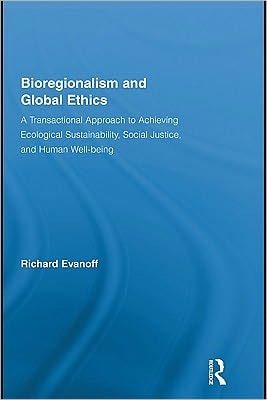
Bioregionalism and Global Ethics: A Transactional Approach to Achieving Ecological Sustainability, Social Justice, and Human Well-Being
0
0
As an Amazon Associate and affiliate partner, Menrva Books earns from qualifying purchases. Learn more
Author Description
While a number of schools of environmental thought — including social ecology, ecofeminism, ecological Marxism, ecoanarchism, and bioregionalism — have attempted to link social issues to a concern for the environment, environmental ethics as an academic discipline has tended to focus more narrowly on ethics related either to changes in personal values or behavior, or to the various ways in which nature might be valued. What is lacking is a framework in which individual, social, and environmental concerns can be looked at not in isolation from each other, but rather in terms of their interrelationships. In this book, Evanoff aims to develop just such a philosophical framework — one in which ethical questions related to interactions between self, society, and nature can be discussed across disciplines and from a variety of different perspectives. The central problem his study investigates is the extent to which a dichotomized view of the relationship between nature and culture, perpetuated in ongoing debates over anthropocentric vs. ecocentric approaches to environmental ethics, might be overcome through the adoption of a transactional perspective, which offers a more dynamic and coevolutionary understanding of how humans interact with their natural environments. Unlike anthropocentric approaches to environmental ethics, which often privilege human concerns over ecological preservation, and some ecocentric approaches, which place more emphasis on preserving natural environments than on meeting human needs, a transactional approach attempts to create more symbiotic and less conflictual modes of interaction between human cultures and natural environments, which allow for the flourishing of both.
Menrva's Summary
THE THESIS
This work investigates whether a transactional philosophical framework can resolve the persistent dichotomy between anthropocentric and ecocentric approaches to environmental ethics. Richard Evanoff, a scholar in environmental philosophy, synthesizes diverse schools of thought including social ecology and ecoanarchism to propose a coevolutionary model. By moving beyond the binary of human-centered versus nature-centered values, the author argues for a more integrated approach that addresses the interdependencies between individual behavior, social structures, and ecological health.
THE SCOPE MAP
What You Will Find
- A comparative analysis of environmental ethics frameworks such as social ecology, ecofeminism, and ecological Marxism.
- A philosophical methodology centered on transactionalism to bridge the gap between culture and nature.
- Theoretical arguments for achieving simultaneous ecological sustainability and social justice.
- A proposed model for symbiotic interaction between human societies and their local bioregions.
THE AUTHORITY PERSPECTIVE
Scholars and practitioners in the field of environmental ethics recognize this text as a significant contribution to the discourse on integrated sustainability. Readers frequently note the academic density of the prose, which serves as a rigorous foundation for those seeking to reconcile human development with ecological preservation.
Page Count:
285
Publication Date:
2010-01-01
Publisher:
Taylor & Francis Group
ISBN-10:
0203843088
ISBN-13:
9780203843086
Philosophy
Sustainability
Social justice
Human ecology
Regionalism
Community Tags
Similar Books