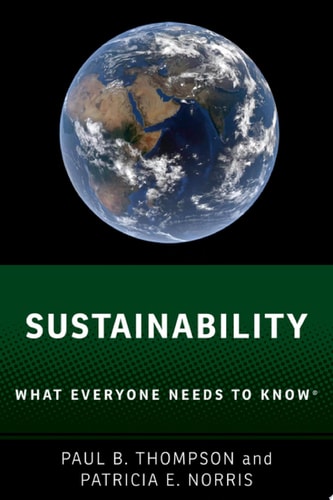
Sustainability: What Everyone Needs to Know
0
0
As an Amazon Associate and affiliate partner, Menrva Books earns from qualifying purchases. Learn more
Author Description
While politicians, entrepreneurs, and even school children could tell you that sustainability is an important and nearly universal value, many of them, and many of us, may struggle to define the term, let alone trace its history. What is sustainability? Is it always about the environment? What science do we need to fully grasp what it requires? What does sustainability mean for business? How can governments plan for a sustainable future? This short, accessible book written in the signature question-and-answer format of the What Everyone Needs to Know® series tackles these and numerous other questions. Sustainability is a porous topic, which has been adapted and reshaped for developing ecological models, improving corporate responsibility, setting environmental and land-use policies, organizing educational curricula, and reimagining the goals of governance and democracy. Where other treatments of this topic tend to focus on just one application of sustainability, this primer encompasses everything from global development and welfare to social justice and climate change. With chapters that discuss sustainability in the contexts of profitable businesses, environmental risks, scientific research, and the day-to-day business of local government, it gives readers a deep understanding of one of the most essential concepts of our time. Bringing to bear experience in natural resource conservation, agriculture, the food industry, and environmental ethics, authors Paul B. Thompson and Patricia E. Norris explain clearly what sustainability means, and why getting it right is so important for the future of our planet.
Menrva's Summary
THE THESIS
This book investigates the multifaceted definition and practical application of sustainability across environmental, economic, and social domains. Authors Patricia E. Norris and Paul B. Thompson, experts in natural resource conservation and environmental ethics, utilize a structured question-and-answer framework to clarify how sustainability functions as a guiding principle for governance, corporate responsibility, and global development. They argue that understanding sustainability requires integrating scientific data with ethical considerations to address the complexities of modern resource management.
THE SCOPE MAP
What You Will Find
- Analysis of sustainability in corporate and business models
- Examination of environmental risk management and land-use policy
- Discussion on the intersection of social justice and global development
- Application of sustainability principles in local government and democracy
Scope Limits
- Does not provide a singular, narrow technical manual for specific engineering solutions
- Does not focus exclusively on climate change to the exclusion of social and economic factors
THE AUTHORITY PERSPECTIVE
Experts highlight this text as a highly accessible primer that successfully synthesizes complex interdisciplinary concepts for a general audience. Readers frequently note that the question-and-answer format effectively organizes the broad scope of the topic into manageable, logical segments.
Page Count:
272
Publication Date:
2021-01-01
Publisher:
Oxford University Press
ISBN-10:
019088326X
ISBN-13:
9780190883263
Non-Fiction
Philosophy
Nature
Economic History
Social justice
Developing Countries
Public Policy
Sustainability
Professional Career & Trade
Community Tags
Similar Books