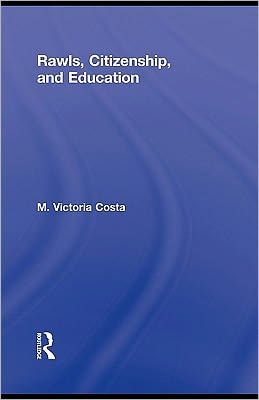
Rawls, Citizenship, and Education
Author Description
This book develops and applies a unified interpretation of John Rawls’ theory of justice as fairness in order to clarify the account of citizenship that Rawls relies upon, and the kind of educational policies that the state can legitimately pursue to promote social justice. Costa examines the role of the family as the "first school of justice" and its basic contribution to the moral and political development of children. It also argues that schools are necessary to supplement the education that families provide, teaching the political virtues that support just social institutions. The book also examines the questions of whether civic education should aim at cultivating patriotic feelings, and how it should respond to the deep cultural pluralism of contemporary democratic societies.
Menrva's Summary
THE THESIS
This book investigates how John Rawls’ theory of justice as fairness informs the requirements of citizenship and the legitimate scope of state-sponsored educational policy. M. Victoria Costa, a scholar of political philosophy, synthesizes Rawlsian concepts to evaluate the moral development of children within the family unit and the subsequent role of public schooling. The text argues that schools serve as essential institutions for fostering political virtues necessary to sustain a just society, while addressing the tensions between civic education and cultural pluralism.
THE SCOPE MAP
What You Will Find
- An analysis of the family as the primary site for moral and political development.
- A framework for evaluating state-led educational policies through the lens of justice as fairness.
- An examination of the role of schools in teaching political virtues and civic responsibility.
- A discussion on the challenges of balancing patriotic education with the realities of cultural diversity.
THE AUTHORITY PERSPECTIVE
Scholars in political philosophy and educational theory identify this work as a rigorous application of Rawlsian thought to contemporary civic challenges. Readers frequently note the academic density of the prose, which serves as a specialized resource for those studying the intersection of liberal theory and public policy.
Page Count:
194
Publication Date:
2010-01-01
Publisher:
Taylor & Francis Group
ISBN-10:
0203846621
ISBN-13:
9780203846629
Philosophy
Citizenship
Social justice
Education
Ethics
Democracy and education
Community Tags
Similar Books