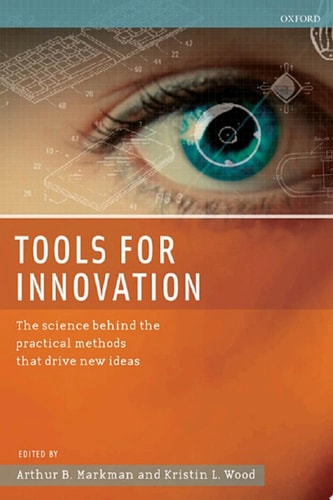
Tools for Innovation: The Science Behind the Practical Methods That Drive New Ideas
0
0
As an Amazon Associate and affiliate partner, Menrva Books earns from qualifying purchases. Learn more
Author Description
It is widely known that innovation is crucial to sustain success in business, government, and engineering. But capturing the effective means of fostering innovation remains elusive. How can organizations actively promote innovation, which arises from a complex combination of cognition and domain expertise? Researchers across an array of fields are studying innovation, with exciting new findings suggesting that science is beginning to understand how it can be cultivated. It is now more important than ever for seemingly distant fields to share conclusions and, in concert, translate them into viable applications.In this unique and exciting collaboration, engineers, cognitive scientists, psychologists, computer scientists, and marketers explore the practical methods that support innovation and creative design, from different ways of thinking and conceptualizing to computer-based tools. The authors present research on processes as well as on the evaluation of existing methods. Their lessons drawn are at the forefront of the interdisciplinary movement to use science to help organizations thrive.
Menrva's Summary
THE THESIS
This book investigates how scientific principles from cognitive science, engineering, and psychology can be translated into practical, actionable methods for fostering innovation within organizations. The authors, Arthur B. Markman and Kristin L. Wood, leverage their interdisciplinary expertise to synthesize research on human cognition and domain-specific knowledge. By bridging the gap between theoretical findings and organizational application, they provide a framework for evaluating and implementing tools that drive creative design and new idea generation.
THE SCOPE MAP
What You Will Find
- Analysis of cognitive processes involved in creative thinking
- Evaluation of computer-based tools for innovation
- Interdisciplinary research synthesis from psychology, engineering, and marketing
- Methodologies for conceptualizing and designing new products
Scope Limits
- Does not provide a singular, universal formula for innovation
- Does not focus on specific industry-wide case studies or historical business biographies
THE AUTHORITY PERSPECTIVE
Experts recognize this text as a valuable interdisciplinary bridge for professionals and academics seeking to apply cognitive science to organizational design. Readers frequently note that the prose maintains a high level of academic rigor while remaining accessible to those interested in the mechanics of creative processes.
Page Count:
256
Publication Date:
2009-01-01
Publisher:
Oxford University Press
ISBN-10:
0190452358
ISBN-13:
9780190452353
Business
Engineering
English
Linguistics
Creative ability
Creative thinking
Management
English & College Success
Creativity
Innovation
Community Tags
Similar Books