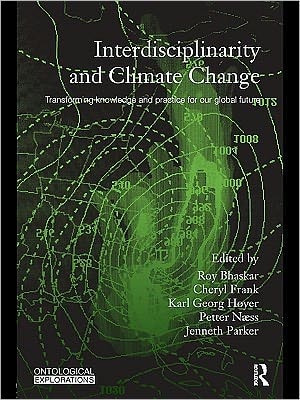
Interdisciplinarity and Climate Change: Transforming Knowledge and Practice for Our Global Future
0
0
As an Amazon Associate and affiliate partner, Menrva Books earns from qualifying purchases. Learn more
Author Description
Interdisciplinarity and Climate Change is a major new book addressing one of the most challenging questions of our time. Its unique standpoint is based on the recognition that effective and coherent interdisciplinarity is necessary to deal with the issue of climate change, and the multitude of linked phenomena which both constitute and connect to it. In the opening chapter, Roy Bhaskar makes use of the extensive resources of critical realism to articulate a comprehensive framework for multidisciplinarity, interdisciplinarity, transdisciplinarity and cross-disciplinary understanding, one which duly takes account of ontological as well as epistemological considerations. Many of the subsequent chapters seek to show how this general approach can be used to make intellectual sense of the complex phenomena in and around the issue of climate change, including our response to it.Among the issues discussed, in a number of graphic and compelling studies, by a range of distinguished contributors, both activists and scholars, are:The dangers of reducing all environmental, energy and climate gas issues to questions of carbon dioxide emissionsThe problems of integrating natural and social scientific work and the perils of monodisciplinary tunnel visionThe consequences of the neglect of issues of consumption in climate policyThe desirability of a care-based ethics and of the integration of cultural considerations into climate policyThe problem of relating theoretical knowledge to practical action in contemporary democratic societiesInterdisciplinarity and Climate Change is essential reading for all serious students of the fight against climate change, the interactions between governmental bodies, and critical realism.
Menrva's Summary
THE THESIS
This book investigates how interdisciplinary frameworks can be effectively applied to address the multifaceted and interconnected challenges posed by global climate change. The authors, including Roy Bhaskar and a team of scholars and activists, utilize the principles of critical realism to bridge the gap between ontological understanding and practical policy implementation. By critiquing monodisciplinary approaches, the text argues for a more integrated methodology that synthesizes natural science, social science, and ethical considerations to foster meaningful climate action.
THE SCOPE MAP
What You Will Find
- A comprehensive framework for multidisciplinarity, interdisciplinarity, and transdisciplinarity based on critical realism.
- Critical analysis of the limitations inherent in focusing exclusively on carbon dioxide emissions.
- Examination of the disconnect between theoretical knowledge and practical application in democratic societies.
- Discussion on the role of care-based ethics and cultural integration in shaping future climate policy.
THE AUTHORITY PERSPECTIVE
Experts and scholars in the field of environmental studies recognize this work as a significant contribution to the methodological debate surrounding climate policy. Readers frequently note the academic density of the prose, which requires a foundational understanding of critical realism to fully grasp the proposed interdisciplinary models.
Page Count:
263
Publication Date:
2010-01-01
Publisher:
Routledge
ISBN-10:
0203855310
ISBN-13:
9780203855317
Philosophy
Globalization
Climate Change
Climatic changes
Interdisciplinary Studies
Interdisciplinary approach to knowledge
Sociology
Community Tags
Similar Books





Reader Comments
Share Your Thoughts
No comments yet. Be the first to share your thoughts!