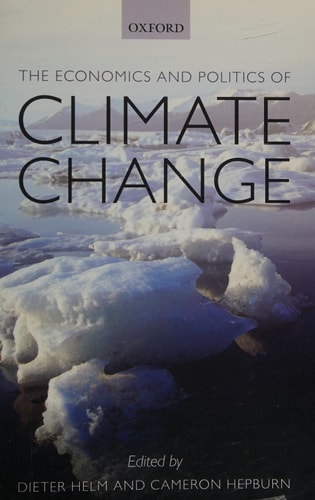
The Economics and Politics of Climate Change
0
0
As an Amazon Associate and affiliate partner, Menrva Books earns from qualifying purchases. Learn more
Author Description
The international framework for a climate change agreement is up for review as the initial Kyoto period to 2012 comes to an end. Though there has been much enthusiasm from political and environmental groups, the underlying economics and politics remain highly controversial. This book takes a cool-headed look at the critical roadblocks to agreement, examining the economics of climate change, the incentives of the main players (the U.S., EU, China) and examines the policies governments can put in place to reduce greenhouse gas emissions, and ultimately shift our economies onto a low-carbon path. The volume brings together leading climate change policy experts to set out the economic analysis and the nature of the negotiations at Copenhagen and beyond. In addition to reviewing the main issues discussed above, a number of the articles question the basis of much of the climate change consensus, and debate the Stern Report's main findings.The book is in four parts. Following an overview of the main issues, the first part is a reassessment of the economics of climate change. This is fundamental to the rest of the volume, and it contains new material which goes well beyond what might be called the new conventional wisdom. The second part looks at the geography of the costs and benefits of climate change--the very different perspectives of Africa, China, the U.S. and Europe. These chapters provide a building block to considering the prospects for a new global agreement--the very different interests that will have to be reconciled at Copenhagen and beyond. The third part looks at policy instruments at the global level (whereas much of the literature to date is nationally and regionally based). Trading and R&D feature in the chapters, but so too do more radical unilateral options, including geo-engineering. Part four turns to the institutional architecture--drawing on evidence from previous attempts in other areas, as well as proposals for new bodies.
Menrva's Summary
THE THESIS
This volume investigates the complex economic and political obstacles that prevent a cohesive international agreement on climate change mitigation. Editors Cameron Hepburn and Dieter Helm assemble a collection of expert analyses to challenge conventional wisdom regarding the Stern Report and the feasibility of current global negotiation frameworks. By examining the divergent incentives of major powers like the U.S., China, and the EU, the authors provide a rigorous assessment of the institutional and policy-based shifts required to transition toward a low-carbon global economy.
THE SCOPE MAP
What You Will Find
- A critical reassessment of the economic foundations of climate change policy and the Stern Report.
- Comparative analysis of the geographic distribution of costs and benefits across Africa, China, the U.S., and Europe.
- Evaluation of global policy instruments, including carbon trading, research and development, and geo-engineering.
- Proposals for institutional architecture and governance models to facilitate future international climate agreements.
THE AUTHORITY PERSPECTIVE
Experts and academics frequently cite this volume as a foundational text for understanding the intersection of climate policy and international political economy. Readers often note the academic density of the prose, which provides a sophisticated, non-partisan framework for evaluating the challenges of global environmental governance.
Page Count:
546
Publication Date:
2011-11-07
Publisher:
Oxford University Press
ISBN-10:
0199606277
ISBN-13:
9780199606276
Economics
Climatic changes
Climate Change
International relations
Community Tags
Other Editions(2)

Similar Books







Reader Comments
Share Your Thoughts
No comments yet. Be the first to share your thoughts!