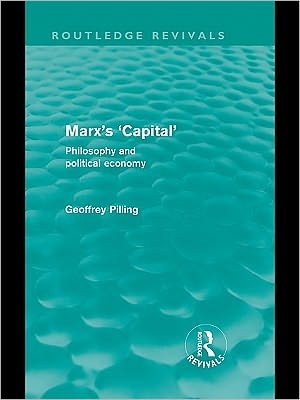
Marx's 'Capital': Philosophy and Political Economy
0
0
As an Amazon Associate and affiliate partner, Menrva Books earns from qualifying purchases. Learn more
Author Description
Marx's Capital has of course been widely read; this revival of a systematic study by Geoffrey Pilling, originally published in 1980, argues powerfully that, in order to understand Capital fully, it is necessary to have read and understood Hegel's Logic. This argument leads to a detailed examination of the opening chapters of Capital, and a re-examination of their significance for the work as a whole.Pilling emphasizes the fundamental nature of the break between Marx's Capital and all forms of classical political economy, and stresses the revolutionary nature of Marx's critique of political economy as one of the foundations of Capital. He also lays particular emphasis on the philosophical aspects of the work, so often neglected by British commentators, and puts forward the view that Marx's notion of fetishism, often looked upon as incidental to his work, is in fact central to his entire critique of political economy.
Menrva's Summary
THE THESIS
This book investigates the core question of whether a comprehensive understanding of Marx's 'Capital' is possible without a rigorous engagement with the philosophical foundations of Hegel's 'Logic'. Geoffrey Pilling, an academic scholar of Marxist theory, utilizes a historical and philosophical framework to argue that the methodological structure of 'Capital' is fundamentally rooted in Hegelian dialectics. By re-examining the opening chapters of Marx's seminal work, Pilling challenges traditional interpretations that isolate Marx's economic analysis from his philosophical development. He asserts that the concept of fetishism is not a peripheral observation but the central mechanism of Marx's critique of classical political economy.
THE SCOPE MAP
What You Will Find
- A detailed philosophical analysis of the opening chapters of 'Capital'.
- A comparative study between Hegelian dialectical logic and Marxian economic theory.
- An examination of the historical break between Marx and classical political economists like Smith and Ricardo.
- A re-evaluation of the concept of commodity fetishism as a foundational element of Marx's critique.
THE AUTHORITY PERSPECTIVE
Scholars and students of political economy frequently cite this text for its focus on the often-overlooked philosophical underpinnings of Marx's work. Experts highlight the book as a rigorous, albeit dense, contribution to the study of Marxist methodology that remains relevant for those seeking to bridge the gap between economic theory and Hegelian philosophy.
Page Count:
216
Publication Date:
2009-12-16
Publisher:
Taylor & Francis Group
ISBN-10:
0203857275
ISBN-13:
9780203857274
Philosophy
Economics
Marxism
Community Tags
Other Editions(3)


Similar Books