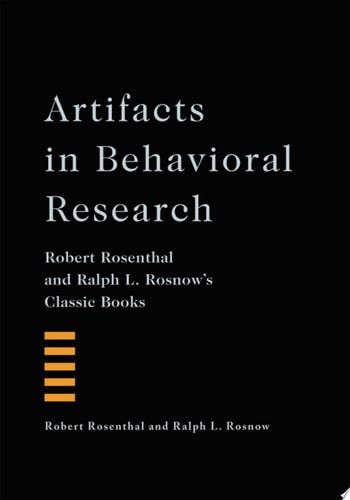
Artifacts in Behavioral Research: Robert Rosenthal and Ralph L. Rosnow's Classic Books
0
0
As an Amazon Associate and affiliate partner, Menrva Books earns from qualifying purchases. Learn more
Author Description
This new combination volume of three-books-in-one, dealing with the topic of artifacts in behavioral research, was designed as both introduction and reminder. It was designed as an introduction to the topic for graduate students, advanced undergraduates, and younger researchers. It was designed as a reminder to more experienced researchers, in and out of academia, that the problems of artifacts in behavioral research, that they may have learned about as beginning researchers, have not gone away. For example, problems of experimenter effects have not been solved. Experimenters still differ in the ways in which they see, interpret, and manipulate their data. Experimenters still obtain different responses from research participants (human or infrahuman) as a function of experimenters' states and traits of biosocial, psychosocial, and situational origins. Experimenters' expectations still serve too often as self-fulfilling prophecies, a problem that biomedical researchers have acknowledged and guarded against better than have behavioral researchers; e.g., many biomedical studies would be considered of unpublishable quality had their experimenters not been blind to experimental condition. Problems of participant or subject effects have also not been solved. We usually still draw our research samples from a population of volunteers that differ along many dimensions from those not finding their way into our research. Research participants are still often suspicious of experimenters' intent, try to figure out what experimenters are after, and are concerned about what the experimenter thinks of them.
Menrva's Summary
THE THESIS
This volume investigates the persistent influence of experimental artifacts—unintended variables that skew research outcomes—within the field of behavioral science. Authors Robert Rosenthal and Ralph L. Rosnow, both established figures in psychological research methodology, synthesize decades of work to address how experimenter expectations and participant behaviors compromise data integrity. The text serves as both a foundational introduction for students and a critical warning to seasoned researchers that methodological biases remain largely unresolved in contemporary practice.
THE SCOPE MAP
What You Will Find
- Analysis of experimenter effects, including biosocial and psychosocial traits.
- Examination of participant volunteer bias and demand characteristics.
- Discussion of self-fulfilling prophecies in experimental design.
- Comparative analysis between behavioral and biomedical research standards.
Scope Limits
- Does not provide a comprehensive guide to advanced statistical software.
- Does not cover qualitative research methodologies in depth.
THE AUTHORITY PERSPECTIVE
Experts identify this collection as a foundational text for understanding the limitations of behavioral data collection. Readers frequently note the academic density of the prose, which is tailored specifically for those engaged in formal research design.
Page Count:
906
Publication Date:
2009-01-01
Publisher:
Oxford University Press
ISBN-10:
0190452587
ISBN-13:
9780190452582
Psychology
Research Methods
Social Research
Statistics
Behavioral Science
Methodology
Community Tags
Similar Books