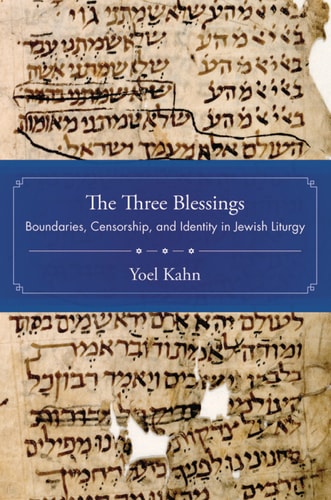
The Three Blessings: Boundaries, Censorship, and Identity in Jewish Liturgy
0
0
As an Amazon Associate and affiliate partner, Menrva Books earns from qualifying purchases. Learn more
Author Description
In the traditional Jewish liturgy, a man thanks God daily for not having been made a gentile, a woman, or a slave. Yoel Kahn traces the history of this prayer from its extra-Jewish origins to the present, demonstrating how different generations and communities understood the significance of these words. Marginalized and persecuted groups used this prayer to mark the boundary between "us" and "them," affirming their own identity and sense of purpose. After the medieval Church seized and burned books it considered offensive, new, coded formulations of the three blessings emerged as forms of spiritual resistance. Book owners voluntarily expurgated the passage to save the books from being destroyed, creating new language and meaning while seeking to preserve the structure and message of the received tradition. During the Renaissance, Jewish women defied their rabbis and declared their gratitude at being "made a woman and not a man." And, as Jewish emancipation began in the nineteenth century, Jews again had to balance fealty to historical practice with their place in the world. Seeking to be recognized as modern and European, early modern Jews rewrote the liturgy to suit modern sensibilities and identified themselves with the Christian West against the historical pagan and the uncivilized infidel.The Three Blessings is an insightful and wide-ranging study of one of the most controversial Jewish prayers, showing its constantly evolving language, usage, and interpretation over the past 2,000 years.
Menrva's Summary
THE THESIS
This book investigates the historical evolution, theological controversy, and social function of the Jewish prayer thanking God for not being made a gentile, a woman, or a slave. Yoel Kahn, a scholar of Jewish history and liturgy, examines how this specific prayer served as a mechanism for identity formation and spiritual resistance across two millennia. By analyzing liturgical texts and historical records, the author demonstrates how communities adapted these blessings to navigate persecution, gender dynamics, and the pressures of modern emancipation.
THE SCOPE MAP
What You Will Find
- Historical analysis of the prayer's origins and its transformation from antiquity to the modern era.
- Documentation of how medieval communities used coded language to resist censorship and book burning.
- Examination of gender-based reinterpretations during the Renaissance and the impact of nineteenth-century European integration.
Scope Limits
- The study focuses specifically on the evolution of this particular liturgical passage rather than a comprehensive history of all Jewish prayer.
- The analysis is primarily centered on the intersection of liturgy with social and political identity rather than purely abstract theological debate.
THE AUTHORITY PERSPECTIVE
Scholars and readers frequently note the meticulous archival research and the clarity with which Kahn navigates complex historical shifts in religious practice. Experts highlight this work as a significant contribution to the study of how marginalized groups utilize religious texts to assert agency and adapt to changing social landscapes.
Page Count:
240
Publication Date:
2010-01-01
Publisher:
Oxford University Press
ISBN-10:
0190451823
ISBN-13:
9780190451820
History
Religion
Theology
Judaism
Talmud
Jews identity
Liturgy
Community Tags
Similar Books