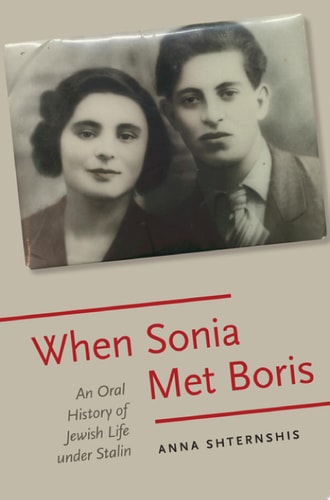
When Sonia Met Boris: An Oral History of Jewish Life under Stalin
0
0
As an Amazon Associate and affiliate partner, Menrva Books earns from qualifying purchases. Learn more
Author Description
Russian-speaking Jews from the former Soviet Union are a peculiarity in the Jewish world. After decades living in a repressive, nominally atheistic state, these Jews did manage to retain a strong sense of Jewish identity--but one that was almost completely divorced from Judaism. Today, more than ten percent of Jews speak or understand Russian, signaling the importance of an ever-vexing question: why are Russian Jews the way they are?In pursuit of an answer, Anna Shternshis's groundbreaking When Sonia Met Boris: An Oral History of Jewish Life under Stalin draws on nearly 500 oral history interviews on the Soviet Jewish experience with Soviet citizens who were adults by the 1940s. Soviet Jews lived through tumultuous times: the Great Terror, World War II, the anti-Semitic policies of the postwar period, and the collapse of the Soviet Union. But, like millions of other Soviet citizens, they married, raised children, and built careers, pursuing life as best they could in a profoundly hostile environment. One of the first scholars to record and analyze oral testimonies of Soviet Jews, Shternshis unearths heartbreaking, deeply poignant, and often funny stories of the everyday choices Jews were forced to navigate as a repressed minority living in a totalitarian regime. Shternshis reveals how ethnicity rapidly transformed into a disability, as well as a negative characteristic, for Soviet Jews in the postwar period, and shows how it was something they needed desperately to overcome in order to succeed.That sense of self has persisted well into the twenty-first century, and has impacted the Jewish identities of the children and grandchildren of Shternshis's subjects, the foundational generation of contemporary Russian Jewish culture. An illuminating work of social and cultural history, When Sonia Met Boris traces the fascinating contours of contemporary Russian Jewish identity back to their very roots.
Menrva's Summary
THE THESIS
This work investigates how Soviet Jews maintained a distinct ethnic identity while navigating the pressures of assimilation and state-sponsored repression during the Stalinist era. Anna Shternshis, a scholar of Yiddish and Jewish history, utilizes a vast archive of nearly 500 oral history interviews to reconstruct the daily lives of citizens who reached adulthood in the 1940s. The book argues that Jewish identity in the Soviet Union was not defined by religious practice, but by a complex negotiation of ethnicity as a social disability and a hurdle to professional advancement within a totalitarian framework.
THE SCOPE MAP
What You Will Find
- Analysis of Jewish life during the Great Terror and World War II
- Examination of postwar anti-Semitic state policies
- Documentation of personal narratives regarding family, career, and marriage
- Insights into the transformation of ethnic identity into a negative social characteristic
Scope Limits
- The study focuses primarily on the generation that was adult by the 1940s
- The text does not provide a comprehensive political history of the Soviet state apparatus
THE AUTHORITY PERSPECTIVE
Scholars and historians recognize this work as a foundational contribution to the study of Soviet Jewish life, particularly for its reliance on primary oral testimonies. Readers frequently note the academic rigor of the research while appreciating the accessibility of the personal narratives presented throughout the text.
Page Count:
264
Publication Date:
2017-01-01
Publisher:
Oxford University Press
ISBN-10:
019022312X
ISBN-13:
9780190223120
History
Religion
Sociology
Soviet History
Asia history
Modern History
Jews
Jews biography
Jews identity
Jewish History
European History
Jews economic conditions
Jewish Studies
Judaism
Oral History
Community Tags
Similar Books