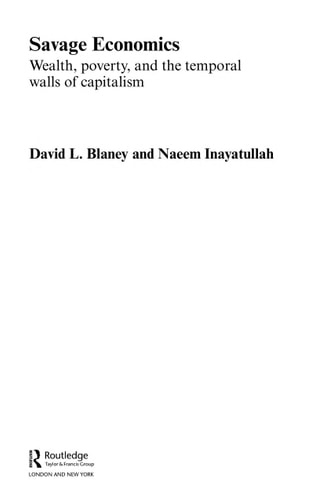
Savage Economics: Wealth, Poverty and the Temporal Walls of Capitalism
0
0
As an Amazon Associate and affiliate partner, Menrva Books earns from qualifying purchases. Learn more
Author Description
This innovative book challenges the most powerful and pervasive ideas concerning political economy, international relations, and ethics in the modern world.Rereading classical authors including Adam Smith, James Steuart, Adam Ferguson, Hegel, and Marx, it provides a systematic and fundamental cultural critique of political economy and critically describes the nature of the mainstream understanding of economics. Blaney and Inayatullah construct a powerful argument about how political economy and the capitalist market economy should be understood, demonstrating that poverty is a product of capitalism itself. They address the questions: Is wealth for some bought at the cost of impoverishing, colonizing, or eradicating others? What benefits of wealth might justify these human costs? What do we gain and lose by endorsing a system of wealth creation? Do even "savage cultures" contain values, critiques, and ways of life that the West still needs? Opening the way for radically different policies addressing poverty and demanding a rethink of the connections between political economy and international relations, this thought-provoking book is vital reading for students and scholars of politics, economics, IPE and international relations.
Menrva's Summary
THE THESIS
This book investigates whether the structural mechanisms of global capitalism inherently produce poverty as a necessary byproduct of wealth accumulation. David L. Blaney and Naeem Inayatullah utilize a critical cultural lens to re-examine foundational texts from classical economists such as Adam Smith, James Steuart, and Karl Marx. By deconstructing mainstream economic assumptions, the authors argue that the modern capitalist framework relies on the marginalization and colonization of non-Western cultures to sustain its growth.
THE SCOPE MAP
What You Will Find
- A systematic cultural critique of classical political economy and its modern interpretations.
- An analysis of the ethical trade-offs between wealth creation and human impoverishment.
- A re-evaluation of the historical relationship between international relations and capitalist expansion.
- Theoretical frameworks for addressing poverty that challenge conventional neoliberal policy.
THE AUTHORITY PERSPECTIVE
Scholars in the fields of international political economy and critical theory frequently cite this work for its rigorous interrogation of Western economic orthodoxy. Experts highlight the text as a challenging resource for those seeking to understand the intersection of historical philosophy and contemporary global inequality.
Page Count:
248
Publication Date:
2009-01-01
Publisher:
Routledge
ISBN-10:
0203864956
ISBN-13:
9780203864951
Economics
Philosophy
Poverty
Wealth
International relations
Social Theory
Capitalism
Community Tags
Similar Books