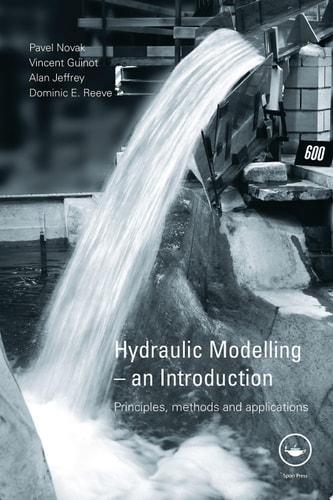
Hydraulic Modelling: Principles, Methods and Applications
0
0
As an Amazon Associate and affiliate partner, Menrva Books earns from qualifying purchases. Learn more
Author Description
SUMMARY: Modelling forms a vital part of all engineering design, yet many hydraulic engineers are not fully aware of the assumptions they make. These assumptions can have important consequences when choosing the best model to inform design decisions. Considering the advantages and limitations of both physical and mathematical methods, this book will help you identify the most appropriate form of analysis for the hydraulic engineering application in question. All models require the knowledge of their background, good data and careful interpretation and so this book also provides guidance on the range of accuracy to be expected of the model simulations and how they should be related to the prototype. Applications to models include: open channel systems closed conduit flows storm drainage systems estuaries coastal and nearshore structures hydraulic structures. An invaluable guide for students and professionals.
Menrva's Summary
THE THESIS
This book investigates the critical relationship between engineering assumptions and the selection of appropriate hydraulic modeling methods. Pavel Novák, an expert in hydraulic engineering, provides a comprehensive framework for evaluating both physical and mathematical models. By examining the underlying principles of simulation, the text guides engineers in navigating the trade-offs between model accuracy and practical design requirements.
THE SCOPE MAP
What You Will Find
- Comparative analysis of physical versus mathematical modeling methodologies.
- Guidance on interpreting simulation data and assessing expected accuracy ranges.
- Application-specific strategies for open channel systems, closed conduit flows, and storm drainage.
- Technical evaluation of modeling requirements for coastal structures and estuaries.
THE AUTHORITY PERSPECTIVE
Experts recognize this work as a foundational text for understanding the limitations and practical applications of hydraulic modeling in professional engineering. Readers frequently note the technical density of the prose, which serves as a reliable reference for both students and practicing engineers.
Page Count:
599
Publication Date:
2010-01-01
Publisher:
Spon Press
ISBN-10:
0203861620
ISBN-13:
9780203861622
Engineering
Technical Reference
Hydrodynamics
Hydraulics
Community Tags
Similar Books