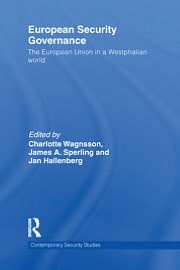
European Security Governance: The European Union in a Westphalian World
0
0
As an Amazon Associate and affiliate partner, Menrva Books earns from qualifying purchases. Learn more
Author Description
This book focuses on the problems of, and prospects for, strengthening the global system of security governance in a manner consistent with the aspirations and practices of the EU. The EU approach to security governance has been successful in its immediate neighbourhood: it has successfully exported its preferred norms and principles to applicant countries, thereby 'pacifying' its immediate neighbourhood and making all of Europe more secure. The EU governance orientation ultimately seeks to enlarge the European security community and expand the geopolitical area within which armed conflicts are inconceivable, and where state and private actors converge around a set of norms and rules of behaviour and engagement.The EU's success along its immediate boundaries has not yet been replicated on a global scale; it remains an open question whether the EU system of governance can be exported globally, owing to different normative structures (for example, a tolerance of armed conflict or non-democratic governance internally), great-power competition (such as US--China), or ongoing processes of securitization that has made it difficult to find a commonly accepted definition of security. Moreover, the EU system of security governance clashes with the continuing unwillingness of other major powers to cede or pool sovereignty as well as varying preferences for unilateral as opposed to multilateral forms of statecraft. This edited volume addresses both the practical and political aspects of security governance and the barriers to the globalization of the EU system of security governance, particularly in the multipolar post-Cold War era.This book will be of great interest to students of security governance, EU politics, European Security and IR in general.James Sperling is Professor of Political Science at the University of Akron, Ohio, USA. Jan Hallenberg is Professor of Political Science at the Department of Security and Strategic Studies, Swedish National Defence College. Charlo
Menrva's Summary
THE THESIS
This volume investigates the feasibility and limitations of exporting the European Union's model of security governance to the broader global stage. Edited by James Sperling, Jan Hallenberg, and Charlotte Wagnsson, the text draws upon the expertise of scholars in political science and strategic studies to analyze the friction between the EU's normative, multilateral approach and the persistent realities of Westphalian state sovereignty. The authors evaluate whether the EU's regional success in conflict prevention can be scaled in a multipolar international system defined by great-power competition and divergent governance structures.
THE SCOPE MAP
What You Will Find
- Analysis of the EU's normative framework and its application in European neighborhood policy.
- Examination of structural barriers to global security governance, including state sovereignty and unilateralism.
- Comparative study of security norms in the post-Cold War era.
- Assessment of the impact of great-power competition on multilateral security initiatives.
THE AUTHORITY PERSPECTIVE
Experts identify this volume as a significant contribution to the study of European security and international relations theory. Readers frequently note the academic density of the prose, making it a suitable resource for advanced students and researchers in the field of global governance.
Page Count:
168
Publication Date:
2009-01-01
Publisher:
Routledge
ISBN-10:
0203875974
ISBN-13:
9780203875971
Geopolitics
International relations
Security Studies
European Union
Community Tags
Similar Books











Reader Comments
Share Your Thoughts
No comments yet. Be the first to share your thoughts!