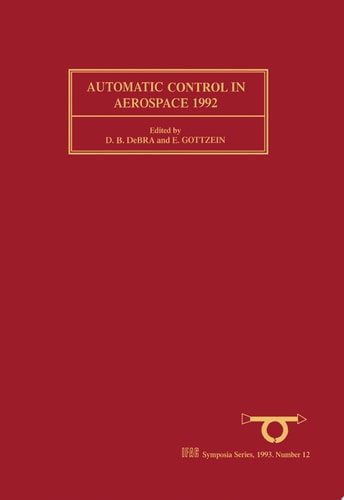
Automatic Control in Aerospace 1992
0
0
As an Amazon Associate and affiliate partner, Menrva Books earns from qualifying purchases. Learn more
Author Description
Space vehicles have become increasingly complex in recent years, and the number of missions has multiplied as a result of extending frontiers in the exploration of our planetary system and the universe beyond. The advancement of automatic control in aerospace reflects these developments. Key areas covered in these proceedings include: the size and complexity of spacecrafts and the increasingly stringent performance requirements to be fulfilled in a harsh and unpredictable environment; the merger of space vehicles and airplanes into space planes to launch and retrieve payloads by reusable winged vehicles; and the demand to increase space automation and autonomy to reduce human involvement as much as possible in manned, man-tended and unmanned missions. This volume covers not only the newly evolving key technologies but also the classical issues of guidance, navigation and control.
Menrva's Summary
THE THESIS
The increasing complexity and mission scope of space exploration necessitate advancements in automatic control systems. The proceedings address the challenges posed by larger, more demanding spacecraft operating in harsh environments, the integration of space planes for reusable launch capabilities, and the drive for greater automation and autonomy in manned and unmanned missions. This volume explores both emerging technologies and foundational principles of guidance, navigation, and control within the aerospace sector.
THE SCOPE MAP
- Challenges in spacecraft size and complexity
- Stringent performance requirements in unpredictable environments
- The concept and development of space planes
- Increasing automation and autonomy in space missions (manned, man-tended, unmanned)
- Evolving key technologies in aerospace control
- Classical issues of guidance, navigation, and control
- Proceedings from the 1992 Automatic Control in Aerospace conference
THE AUTHORITY PERSPECTIVE
This volume compiles the proceedings from the 1992 Automatic Control in Aerospace conference, reflecting the state of the art in a period of significant expansion in space exploration. The topics covered indicate a focus on the practical engineering challenges and technological solutions being developed to manage increasingly complex space vehicles and missions. The emphasis on automation and autonomy suggests a forward-looking perspective on reducing human risk and increasing operational efficiency in space.
Page Count:
556
Publication Date:
2017-01-11
Publisher:
Elsevier S & T
ISBN-10:
1483298744
ISBN-13:
9781483298740
Science & Technology
Non-Fiction
Control systems
Engineering
Aerospace Engineering
Community Tags
Similar Books