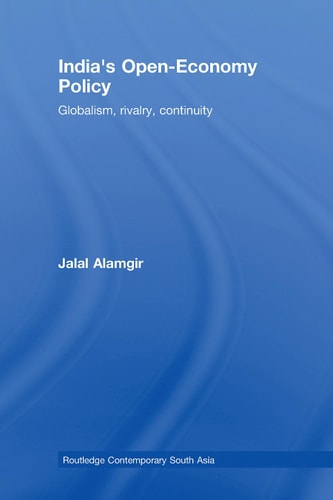
India's Open-Economy Policy: Globalism, Rivalry, Continuity
0
0
As an Amazon Associate and affiliate partner, Menrva Books earns from qualifying purchases. Learn more
Author Description
This book is the first major exploration of Indian political economy using a constructivist approach. Arguing that India’s open-economy policy was made, justified, and continued on the basis of the idea of openness more than its tangible effect, the book explains what sustained the idea of openness, what philosophy, interpretations of history, and international context gave it support, justification, and persuasive force.Drawing on a wide range of contemporary and historical sources, and going as far back as the 19th century, the author reconstructs how Indian policymakers have interpreted economic priorities, perceived success and failure, and evaluated the destiny of their nation. By the 1990s, their imperatives increasingly highlighted a sense of rivalry, especially with China, and globalism, a desire to play a strong role in world affairs. The book shows how a sense of nationalist urgency was created through globalism and rivalry, allowing policymakers to privilege international needs over domestic political demands, replace economic independence with interdependence as a priority, and ensure that the broad basis of India’s openness could not be challenged effectively even though certain policies faced severe opposition.This book will be of interest to those working on International Political Economy, Globalization, Economic History, Public Policy, and South Asian politics.
Menrva's Summary
THE THESIS
This book investigates how the concept of economic openness became a foundational, self-sustaining pillar of Indian political strategy despite varying tangible outcomes. Author Jalal Alamgir, a scholar of political economy, utilizes a constructivist framework to examine how Indian policymakers interpreted historical context and national destiny to justify economic shifts. By analyzing the interplay between nationalist urgency, globalism, and regional rivalry, the text argues that the idea of openness was institutionalized as a necessity for India's international standing.
THE SCOPE MAP
What You Will Find
- Historical analysis of Indian economic policy spanning from the 19th century to the 1990s.
- A constructivist methodology applied to the study of national economic priorities.
- Examination of the geopolitical rivalry between India and China as a driver for domestic policy.
- Evaluation of how international interdependence replaced traditional economic independence as a primary state objective.
THE AUTHORITY PERSPECTIVE
Scholars and students of international political economy recognize this work as a significant contribution to the understanding of India's post-liberalization trajectory. Experts frequently highlight the book's ability to bridge the gap between abstract political philosophy and concrete economic decision-making.
Page Count:
176
Publication Date:
2008-01-01
Publisher:
Routledge
ISBN-10:
0203886976
ISBN-13:
9780203886977
Economic History
Globalization
International relations
Public Policy
Competition