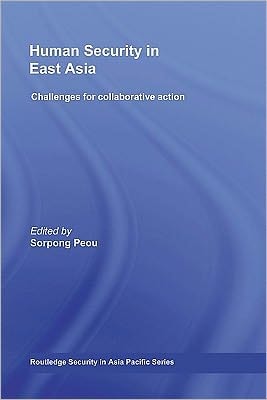
Human Security in East Asia: Challenges for Collaborative Action
0
0
As an Amazon Associate and affiliate partner, Menrva Books earns from qualifying purchases. Learn more
Author Description
Since the end of the Cold War the number of interstate wars has remained relatively low, although whilst states may be more secure than ever this does not mean that individual human beings are too. This has led to a growing recognition of the importance of human security, in contrast to the traditional realist focus on state security. This book explores human security in East Asia, focusing in particular on the challenges to collaboration among actors involved in the process of human security promotion. It examines the theoretical complexities of conceptual arguments about human security, drawing on the ideas of scholars from Asia and the West, to provide a global perspective on what causes human insecurity and how security can best be achieved. It considers in detail case studies of military interventions in East Asia, in particular East Timor, and assesses how successful collaborative efforts have been in providing human security. It also explores case studies of non-military intervention, including international criminal justice in Cambodia and East Timor. It discusses the relationship of regional great powers such as China and Japan to human security promotion, arguing that it will be better served if these powers engage less in the traditional game of geopolitics and if human security objectives do not work against actors' interests. It shows how interventions to uphold human security have not always succeeded to the extent that was hoped, despite the best of intentions, and considers how improved collaboration can be achieved, so that future interventions enjoy more consistent success.
Menrva's Summary
THE THESIS
This book investigates the efficacy of collaborative human security initiatives in East Asia by contrasting individual-centered security models against traditional state-centric realist paradigms. Edited by Sorpong Peou, the volume synthesizes theoretical frameworks from both Asian and Western scholars to evaluate the practical challenges of promoting human security in a region defined by complex geopolitical interests. The contributors analyze the successes and failures of various interventions, arguing that regional stability and individual protection require a shift away from traditional power politics toward more integrated, collaborative strategies.
THE SCOPE MAP
What You Will Find
- Theoretical analysis of human security versus state-centric realist security frameworks.
- Case studies of military interventions, with a specific focus on East Timor.
- Examination of non-military interventions, including international criminal justice efforts in Cambodia.
- Assessment of the roles played by regional powers such as China and Japan in security promotion.
THE AUTHORITY PERSPECTIVE
Experts identify this work as a critical contribution to the discourse on regional security, noting its balanced inclusion of diverse scholarly perspectives. Readers frequently highlight the text's academic rigor and its practical application of theory to specific historical case studies.
Page Count:
208
Publication Date:
2008-01-01
Publisher:
Routledge
ISBN-10:
0203888634
ISBN-13:
9780203888636
Asian Studies
Security Studies
Quality of Life
International Cooperation
Peace Building
Human rights
National security
International relations
Regionalism
Community Tags
Similar Books