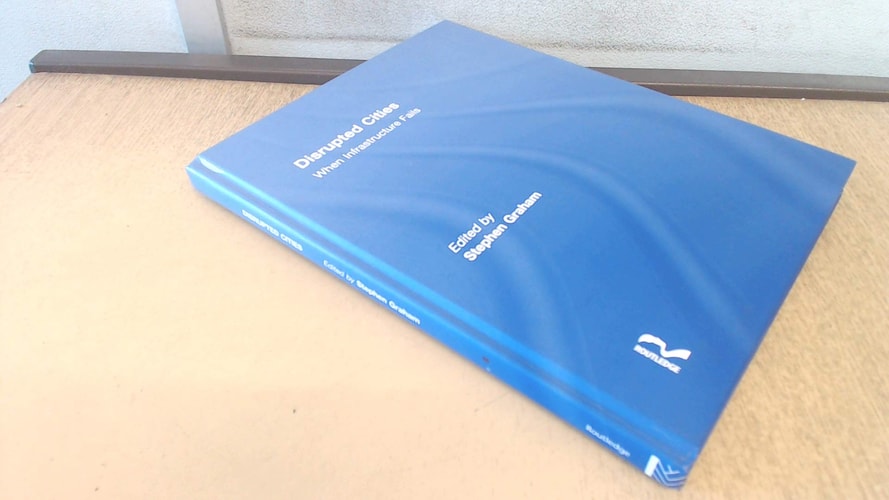
Disrupted Cities: When Infrastructure Fails
0
0
As an Amazon Associate and affiliate partner, Menrva Books earns from qualifying purchases. Learn more
Author Description
Bringing together leading researchers from geography, political science, sociology, public policy and technology studies, Disrupted Cities exposes the politics of well-known disruptions such as devastation of New Orleans in 2005, the global SARS outbreak in 2002-3, and the great power collapse in the North Eastern US in 2003. But the book also excavates the politics of more hidden disruptions: the clogging of city sewers with fat; the day-to-day infrastructural collapses which dominate urban life in much of the global south; the deliberate devastation of urban infrastructure by state militaries; and, the ways in which alleged threats of infrastructural disruption have been used to radically reorganise cities as part of the 'war on terror'. Accessible, topical and state-of-the art, Disrupted Cities will be required reading for anyone interested in the intersections of technology, security and urban life as we plunge headlong into this quintessentially urban century. The book's blend of cutting-edge theory with visceral events means that it will be particularly useful for illuminating urban courses within geography, sociology, planning, anthropology, political science, public policy, architecture and technology studies.
Menrva's Summary
THE THESIS
This book investigates the underlying political and social implications of urban infrastructural failure in an increasingly interconnected global landscape. Edited by Stephen Graham, the work synthesizes contributions from experts in geography, sociology, and political science to analyze how both catastrophic events and mundane technical breakdowns reveal the fragility of modern city systems. The authors argue that infrastructure is not merely a neutral utility, but a site of power, control, and systemic inequality that shapes urban life.
THE SCOPE MAP
What You Will Find
- Analysis of high-profile disasters including the 2005 New Orleans devastation and the 2003 North Eastern US power collapse.
- Examination of everyday infrastructural failures, such as sewer maintenance issues and urban decay in the global south.
- Discussion of the intersection between security policies, the 'war on terror,' and the reorganization of urban spaces.
- Theoretical frameworks connecting technological systems to state military strategies and public policy.
THE AUTHORITY PERSPECTIVE
Experts identify this collection as a foundational text for students and researchers in urban planning and technology studies. Readers frequently note the academic density of the prose, which effectively bridges the gap between abstract theory and concrete historical events.
Page Count:
209
Publication Date:
2009-01-01
Publisher:
Routledge
ISBN-10:
0203894480
ISBN-13:
9780203894484
Sociology
Subjects
Geography
Urban Studies
Technology Studies
Public Policy
Community Tags
Similar Books