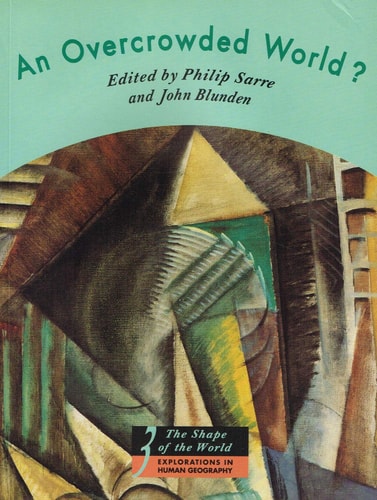
An Overcrowded World?: Population, Resources and the Environment
0
0
As an Amazon Associate and affiliate partner, Menrva Books earns from qualifying purchases. Learn more
Author Description
This book explores the issues of overpopulation and the resulting depletion of natural resources. The main focus is on the impact that developments in one part of the world have upon people's lifestyles, and the forms of inequality dictated by the relationship between rich and poor countries. The study of wilderness and the notion of empty space are used to introduce questions of national resources, sustainability, and ecology. Sustainability provides the framework for discussion of population change, mortality and fertility and the questions of energy resources and environmental degradation. An Overcrowded World demonstrates how uneven development worsens ecological problems in certain areas and prevents a unified global response.
Menrva's Summary
THE THESIS
This book investigates whether the global population growth poses an existential threat to natural resources and environmental stability. Authors John Blunden and Philip Sarre utilize a human geography framework to analyze the intersection of demographic shifts, resource consumption, and economic inequality. By examining the disparities between developed and developing nations, the authors argue that uneven development is a primary driver of ecological degradation and a barrier to effective global environmental policy.
THE SCOPE MAP
What You Will Find
- Analysis of population dynamics including mortality and fertility rates.
- Examination of the relationship between resource depletion and economic inequality.
- Discussion of the concepts of wilderness and empty space in relation to national resources.
- Frameworks for understanding sustainability and environmental degradation in a global context.
THE AUTHORITY PERSPECTIVE
Experts and educators frequently cite this volume as a foundational text for students of human geography and environmental studies. Readers often note the academic rigor of the prose and the clarity with which the authors connect complex demographic data to real-world ecological outcomes.
Page Count:
296
Publication Date:
1996-08-08
Publisher:
The Open University
ISBN-10:
0198741898
ISBN-13:
9780198741893
Sustainability
Human ecology
Ecology
Human Geography
Geography
Sociology
Community Tags
Similar Books