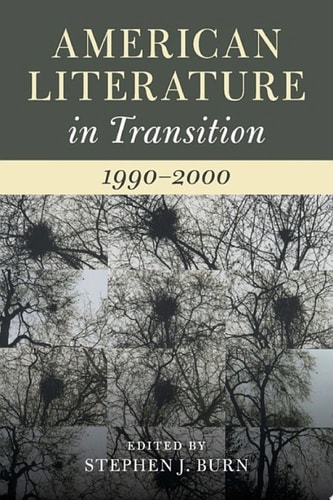
American Literature in Transition, 1990–2000
0
0
As an Amazon Associate and affiliate partner, Menrva Books earns from qualifying purchases. Learn more
Author Description
Written in the shadow of the approaching millennium, American literature in the 1990s was beset by bleak announcements of the end of books, the end of postmodernism, and even the end of literature. Yet, as conservative critics marked the century's twilight hours by launching elegies for the conventional canon, American writers proved the continuing vitality of their literature by reinvigorating inherited forms, by adopting and adapting emerging technologies to narrative ends, and by finding new voices that had remained outside that canon for too long. By reading 1990s literature in a sequence of shifting contexts - from independent presses to the AIDS crisis, and from angelology to virtual reality - American Literature in Transition, 1990–2000 provides the fullest map yet of the changing shape of a rich and diverse decade's literary production. It offers new perspectives on the period's well-known landmarks, Toni Morrison, Thomas Pynchon, David Foster Wallace, but also overdue recognition to writers such as Ana Castillo, Evan Dara, Steve Erickson, and Carole Maso.
Menrva's Summary
THE THESIS
The book investigates the paradoxical state of American literature at the close of the 20th century, a period marked by pronouncements of its demise yet characterized by significant innovation and expansion. Stephen J. Burn, drawing on a wide array of literary works and cultural contexts, argues that despite anxieties surrounding the end of postmodernism and the literary canon, writers of the 1990s actively revitalized traditional forms, integrated new technologies, and amplified previously marginalized voices. The book examines this dynamic period by exploring shifting contexts such as independent publishing, the AIDS crisis, and the rise of virtual reality. Burn offers fresh interpretations of established authors like Toni Morrison and David Foster Wallace while also highlighting the contributions of lesser-known but significant writers.
THE SCOPE MAP
- Analysis of American literature produced between 1990 and 2000.
- Exploration of critical discourse surrounding the 'end of literature' and postmodernism.
- Examination of how writers adapted emerging technologies into narrative.
- Focus on the emergence of new voices previously excluded from the literary canon.
- Contextualization of literary production through independent presses and cultural events.
- Discussion of the impact of the AIDS crisis on literary themes and forms.
- Analysis of specific authors including Toni Morrison, Thomas Pynchon, David Foster Wallace, Ana Castillo, Evan Dara, Steve Erickson, and Carole Maso.
- Consideration of themes related to virtual reality and angelology.
THE AUTHORITY PERSPECTIVE
This book is regarded as a comprehensive mapping of American literary production during a pivotal decade. It is noted for its ability to provide new perspectives on well-known authors while also bringing overdue recognition to writers who operated outside the mainstream. The work's strength lies in its contextual approach, examining literature through diverse lenses from independent presses to the cultural impact of the AIDS crisis. It effectively captures the vitality and evolving landscape of American literature as it transitioned into the 21st century.
Page Count:
635
Publication Date:
2017-12-28
Publisher:
Cambridge University Press
ISBN-10:
1108547397
ISBN-13:
9781108547390
History
Literary Fiction
Non-Fiction
Postmodernism
Literary Criticism
American
Community Tags
Similar Books