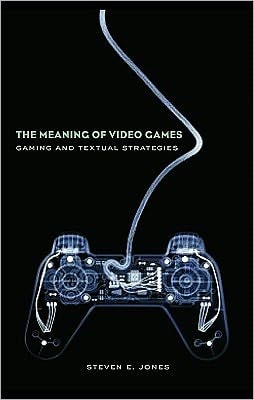
The Meaning Of Video Games: Gaming And Textual Studies
0
0
As an Amazon Associate and affiliate partner, Menrva Books earns from qualifying purchases. Learn more
Author Description
The Meaning of Video Games takes a textual studies approach to an increasingly important form of expression in today’s culture. It begins by assuming that video games are meaningful–not just as sociological or economic or cultural evidence, but in their own right, as cultural expressions worthy of scholarly attention. In this way, this book makes a contribution to the study of video games, but it also aims to enrich textual studies.Early video game studies scholars were quick to point out that a game should never be reduced to merely its "story" or narrative content and they rightly insist on the importance of studying games as games. But here Steven E. Jones demonstrates that textual studies–which grows historically out of ancient questions of textual recension, multiple versions, production, reproduction, and reception–can fruitfully be applied to the study of video games. Citing specific examples such as Myst and Lost, Katamari Damacy, Halo, Façade, Nintendo’s Wii, and Will Wright’s Spore, the book explores the ways in which textual studies concepts–authorial intention, textual variability and performance, the paratext, publishing history and the social text–can shed light on video games as more than formal systems. It treats video games as cultural forms of expression that are received as they are played, out in the world, where their meanings get made.
Menrva's Summary
THE THESIS
This book investigates whether the methodologies of traditional textual studies can be effectively applied to analyze video games as significant cultural expressions. Steven E. Jones, a scholar in digital humanities and textual studies, argues that games should be treated as complex artifacts rather than mere formal systems. By drawing on historical concepts of textual recension, production, and reception, he provides a framework for understanding how games function as social texts that are actively constructed during the act of play.
THE SCOPE MAP
What You Will Find
- Application of textual studies concepts like authorial intention, paratext, and publishing history to digital media.
- Analysis of specific titles including Myst, Katamari Damacy, Halo, and Spore.
- Examination of the relationship between game performance and textual variability.
- Theoretical exploration of how meaning is generated through the interaction between player and game system.
THE AUTHORITY PERSPECTIVE
Scholars and students of game studies recognize this work as a bridge between traditional literary theory and digital media analysis. Readers frequently note the academic density of the prose, which serves as a foundational text for those interested in the intersection of humanities and game design.
Page Count:
208
Publication Date:
2008-01-01
Publisher:
Routledge
ISBN-10:
0203929926
ISBN-13:
9780203929926
Video Games
Media Studies
Technology
Academic
Community Tags
Similar Books