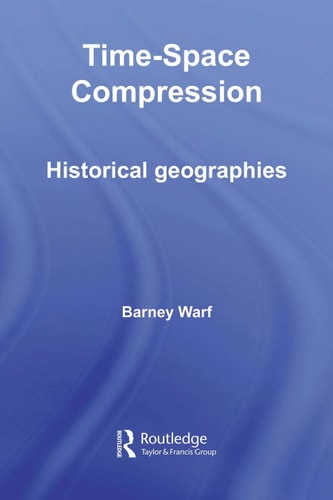
Time-Space Compression: Historical Geographies
0
0
As an Amazon Associate and affiliate partner, Menrva Books earns from qualifying purchases. Learn more
Author Description
If geography is the study of how human beings are stretched over the earth's surface, a vital part of that process is how we know and feel about space and time. Although space and time appear as "natural" and outside of society, they are in fact social constructions; every society develops different ways of measuring, organizing, and perceiving them. Given steady increases in the volume and velocity of social transactions over space, time and space have steadily "shrunk" via the process of time-space compression. By changing the time-space prisms of daily life - how people use their times and spaces, the opportunities and constraints they face, the meanings they attach to them - time-space compression is simultaneously cultural, social, political, and psychological in nature.This book explores how various social institutions and technologies historically generated enormous improvements in transportation and communications that produced transformative reductions in the time and cost of interactions among places, creating ever-changing geographies of centrality and peripherality. Warf invokes a global perspective on early modern, late modern, and postmodern capitalism. He makes use of data concerning travel times at various historical junctures, maps of distances between places at different historical moments, anecdotal analyses based on published accounts of people's sense of place, examinations of cultural forms that represented space (e.g., paintings), and quotes about the culture of speed.Warf shows how time-space compression varies under different historical and geographical conditions, indicating that it is not one, single, homogenous process but a complex, contingent, and contested one. This book will be useful book for those studying and researching Geography, History, Sociology, and Political Science, as well as Anthropology, and Philosophy.
Menrva's Summary
THE THESIS
This book investigates how the social construction of time and space has been fundamentally altered by the historical acceleration of transportation and communication technologies. Barney Warf, a scholar in human geography, utilizes a global perspective to analyze how the shrinking of perceived distances—a process termed time-space compression—has reshaped social, political, and cultural institutions. By synthesizing historical data on travel times, cultural representations of space, and sociological accounts, the author argues that time-space compression is a contingent, non-homogenous process that varies significantly across different capitalist eras.
THE SCOPE MAP
What You Will Find
- Historical analysis of transportation and communication advancements from early modern to postmodern capitalism.
- Methodological use of travel time data and cartographic representations of distance.
- Qualitative evidence derived from cultural artifacts, including paintings and literature, to assess changing perceptions of place.
- A theoretical framework examining the political and psychological impacts of increased social transaction velocity.
THE AUTHORITY PERSPECTIVE
Experts recognize this work as a significant contribution to human geography that bridges the gap between technological history and social theory. Readers frequently note the academic density of the prose, which makes it a valuable resource for researchers in sociology and political science.
Page Count:
272
Publication Date:
2008-01-01
Publisher:
Routledge
ISBN-10:
0203938054
ISBN-13:
9780203938058
History
Philosophy
Human Geography
Space and time
Geography
Sociology
Community Tags
Other Editions(2)
Similar Books










Reader Comments
Share Your Thoughts
No comments yet. Be the first to share your thoughts!