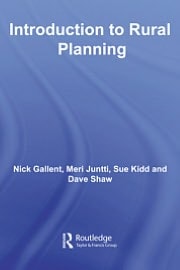
Introduction to rural planning
0
0
As an Amazon Associate and affiliate partner, Menrva Books earns from qualifying purchases. Learn more
Author Description
Providing an overview of rural (spatial) planning for students on planning, geography and related programmes, this book charts the major patterns and processes of rural change affecting the British countryside, its landscape, its communities and its economies in the twentieth century. The authors examine the role of ‘planning’ in shaping rural spaces, not only the statutory ‘comprehensive’ planning that emerged in the post-war period, but also planning and rural programme delivery undertaken by central, regional and local policy agencies. The book is designed to accompany a typical teaching programme in rural planning and considers: the nature of rural areas and the emergence of statutory planning in England the agents of rural policy delivery and the potential for current planning practice to become a ‘policy hub’ at the local level, co-ordinating the actions and programmes of different agents economic change in the countryside and the influence planning has in shaping rural economies social change, the nature of rural communities and recent debates on housing and rural service provision environmental change, the changing fortunes of farming, landscape protection, and the idea of a multi-functional landscape made by forces that can be shaped by the planning process key areas of current concern in spatial rural planning, including debates surrounding city-regions, the rural the challenge of managing rural change in the twenty-first century through new planning and governance processes. A comprehensive coverage of the forces, processes and outcomes of rural change whilst keeping planning’s influence and role in clear view at all times.
Menrva's Summary
THE THESIS
This text investigates the mechanisms of spatial planning and its capacity to manage the complex socio-economic and environmental transformations occurring within the British countryside. The authors, a team of academic experts in planning and geography, utilize a historical and policy-oriented framework to analyze how statutory and regional interventions have shaped rural landscapes since the twentieth century. By evaluating the shift from post-war comprehensive planning to contemporary governance, the book argues for the role of planning as a central hub for coordinating diverse policy agencies and community interests.
THE SCOPE MAP
What You Will Find
- Historical analysis of rural change and the emergence of statutory planning in England.
- Methodologies for coordinating multi-agency policy delivery at the local level.
- Examination of economic, social, and environmental drivers within rural spaces.
- Frameworks for addressing contemporary challenges such as housing, service provision, and landscape protection.
THE AUTHORITY PERSPECTIVE
Academic reviewers and educators frequently identify this work as a foundational text for students of geography and spatial planning. Experts highlight the clarity with which the authors synthesize complex policy processes into a coherent pedagogical structure for classroom use.
Page Count:
364
Publication Date:
2008-01-01
Publisher:
Routledge
ISBN-10:
0203933435
ISBN-13:
9780203933435
Rural Studies
urban planning
Public Policy
Sociology
Great Britain
Geography
Community Tags
Similar Books