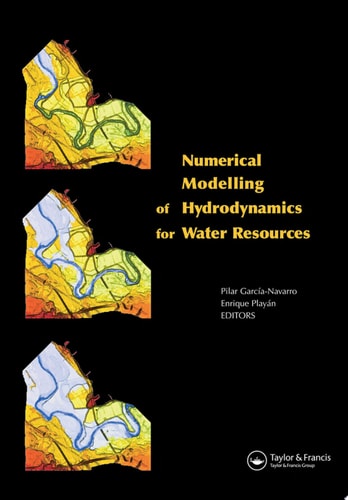
Numerical Modelling of Hydrodynamics for Water Resources: Proceedings of the Conference on Numerical Modelling of Hydrodynamic Systems
0
0
As an Amazon Associate and affiliate partner, Menrva Books earns from qualifying purchases. Learn more
Author Description
Overland Flow Modelling Has Been An Active Field Of Research For Some Years, But Developments In Numerical Methods And Computational Resources Have Recently Accelerated Progress, Producing Models For Different Geometries And Types Of Flows, Such As Simulations Of Canal And River Networks. Flow In Canals Has Traditionally Been Described Using One-dimensional, Depth-averaged, Shallow Water Models; But A Variety Of Simulation Techniques Now Facilitate The Management Of Hydrodynamic Systems, Providing Models Which Incorporate Complex Geometry And Diverse Flows. Much Effort Has Gone Into Elaborating Canal Operational Rules Based On Decision Support Systems, With The Dual Aim Of Assuring Water Delivery And Meeting Flow Control Constraints. In Natural Water Courses, Water Management Problems Are Associated With The Need To Meet Quality Standards. Numerical Modelling Of Advection-diffusion Can Be Used To Manage Problems Related To The Movement Of Solutes In Rivers And Aquifers. The Analysis Of Solute Transport Is Used To Safeguard The Quality Of Surface And Ground Water And To Help Prevent Eutrophication. Solute Flow Through The Soil Can Be Dynamically Linked To Overland Flow For Hydrological And Agricultural Applications. Advances In Modelling Also Cast New Light On Sediment Transport In Rivers, Exploring The Complex Dynamics Of River Bed Erosion And Deposition And Assist In Thee Analysis Of River-reservoir Systems. All These Issues Are Discussed In Numerical Modelling Of Hydrodynamics For Water Resources, Which Will Be Useful To Civil Engineers, Applied Mathematicians, Hydrologists, And Physicists.
Menrva's Summary
THE THESIS
This volume investigates the application of advanced numerical modeling techniques to solve complex hydrodynamic challenges in water resource management. The editors, Enrique Playán and Pilar Garcia Navarro, compile research from a specialized conference to address the intersection of computational fluid dynamics and practical water system operations. The text evaluates how modern numerical methods improve the simulation of canal networks, river systems, and solute transport, providing a framework for engineers and scientists to optimize water delivery and environmental quality.
THE SCOPE MAP
What You Will Find
- Numerical methods for one-dimensional and depth-averaged shallow water models.
- Strategies for canal operational rules and decision support systems.
- Analysis of advection-diffusion processes for solute transport in rivers and aquifers.
- Research on sediment transport, river bed erosion, and deposition dynamics.
THE AUTHORITY PERSPECTIVE
Experts identify this collection as a technical resource for civil engineers and hydrologists working on water infrastructure management. Readers frequently note the academic density of the prose, which assumes a foundational understanding of fluid mechanics and computational mathematics.
Page Count:
402
Publication Date:
2007-01-01
Publisher:
Taylor & Francis Group
ISBN-10:
020393217X
ISBN-13:
9780203932179
Hydrodynamics
Civil Engineering
Fluid dynamics
Applied Mathematics
Hydrology
Community Tags
Similar Books