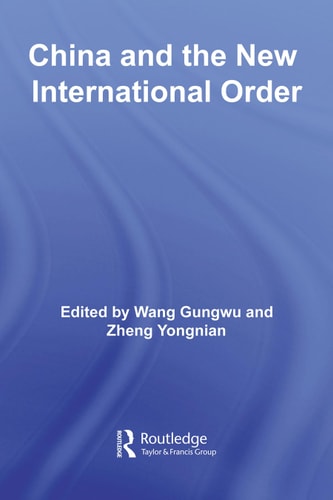
China and the New International Order
0
0
As an Amazon Associate and affiliate partner, Menrva Books earns from qualifying purchases. Learn more
Author Description
This book explores China's place in the 'new international order', from both the international perspective and from the perspective within China.It discusses how far the new international order, as outlined by George Bush in 1991 after the collapse of the Soviet Union and the liberation of Kuwait in the Gulf War, with its notions of 'international order', as viewed by the United States, and with the United States seeing itself as the single dominant power, applies to China. The contributors offer the implications, both positive and negative, of China's growing economic power, and the possibility that China will increase its military power. They also examine the idea that the Chinese leadership is being carried along itself by events in China, which it does not fully control, and that other growing forces within China, such as nationalism, increasing social grievances, structural instability, and rivalry between the centre and the regions potentially work against China's growing strength in the international arena. Considering traditional Chinese notions of 'international' power, where the world is seen as sino-centric, with neighbouring countries subservient to China in varying degrees, the book argues that this represents a fundamentally different view of the international order, one where the equal sovereignty of every state does not apply, where there is an acknowledged hierarchy of power, and where domestic and international issues are highly interdependent.
Menrva's Summary
THE THESIS
This book investigates the complex positioning of China within the post-Cold War international order and the internal domestic pressures that influence its global trajectory. Edited by Wang Gungwu and Zheng Yongnian, the volume compiles scholarly analysis to evaluate how China reconciles its traditional sino-centric worldview with the US-led framework of equal state sovereignty. The contributors examine the interplay between China's rapid economic expansion, its military modernization, and the internal structural instabilities that challenge its rise as a global power.
THE SCOPE MAP
What You Will Find
- Analysis of the post-1991 international order as defined by the United States.
- Examination of traditional Chinese concepts of international hierarchy and power.
- Assessment of internal domestic factors including nationalism, social grievances, and regional rivalry.
- Discussion on the interdependence between China's domestic stability and its international influence.
THE AUTHORITY PERSPECTIVE
Experts recognize this work as a significant contribution to the study of Chinese foreign policy during a pivotal transition period in global politics. Scholars frequently cite the text for its balanced approach in contrasting Western liberal internationalism with historical Chinese perspectives on regional hegemony.
Page Count:
316
Publication Date:
2008-01-01
Publisher:
Routledge
ISBN-10:
0203932269
ISBN-13:
9780203932261
History
China
Geopolitics
International relations
Community Tags
Similar Books