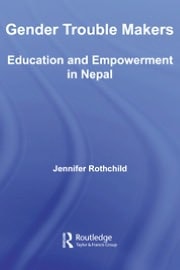
Gender Trouble Makers: Education and Empowerment in Nepal
0
0
As an Amazon Associate and affiliate partner, Menrva Books earns from qualifying purchases. Learn more
Author Description
International development efforts aimed at improving girls’ lives and education have been well-intended, somewhat effective, but ultimately short-sighted and incomplete. This is because international development efforts often operate under a reductive understanding of the term 'gender' and how it influences the lives of girls and boys. Gender is more commonly conceived by international efforts as characteristics which are ascribed to girls as norms for behaviour.In particular, the analysis in Gender Trouble Makers focuses on the social constructions of gender and the ways in which gender was reinforced and maintained through a case study in rural Nepal.In developing countries like Nepal, promoting access to and participation in existing formal education programme is clearly necessary, but it is not, in itself, sufficient to transform gender power relations in the broader society. When gender is properly addressed as a process, then all stakeholders involved - researchers, governmental officials, and community members - can begin to understand and devise more effective ways to increase both girl and boy students’ enrollment, participation, and success in school.
Menrva's Summary
THE THESIS
This book investigates whether increasing access to formal education is sufficient to transform gender power relations in developing nations. Author Jennifer Rothchild, a sociologist, argues that international development initiatives often fail because they rely on a reductive understanding of gender as a static set of behavioral norms rather than a dynamic social process. By examining the lived experiences of students in rural Nepal, the text provides a framework for stakeholders to move beyond simple enrollment metrics toward a more comprehensive approach to gender equity.
THE SCOPE MAP
What You Will Find
- A detailed case study of rural educational environments in Nepal.
- An analysis of how gender is socially constructed and reinforced within local communities.
- Qualitative evidence derived from field research and observations of student participation.
- A critique of current international development methodologies regarding gender and schooling.
THE AUTHORITY PERSPECTIVE
Experts in international development and sociology recognize this work as a critical examination of the limitations inherent in top-down educational policy. Readers frequently note the academic rigor of the author's ethnographic approach and the practical implications for future policy design.
Page Count:
224
Publication Date:
2007-01-01
Publisher:
Taylor & Francis Group
ISBN-10:
0203944305
ISBN-13:
9780203944301
Women
Women nepal
International Development
Social Life
Women education
Gender Studies
Education
Anthropology
Sociology
Socialization
Sex Role
Nepal
Sex Education
Community Tags
Similar Books