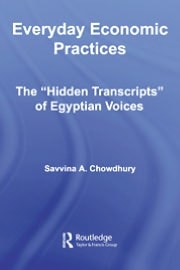
Everyday Economic Practices: The 'Hidden Transcripts' of Egyptian Voices
Author Description
This book brings to the forefront the significance of local everyday economic practices to development policymaking. Chowdhury's objective in unearthing these diverse activities is two-fold. She demonstrates why it is a misrepresentation to characterize all that is economic as capitalism. Additionally, she contends that in those instances of rupture where local economic practices break into dominant narratives of the economy, we catch a glimpse of what James Scott has referred to as the hidden transcripts of alternative epistemologies. Chowdhury argues that the normative content of these other epistemological frameworks provide us with alternative ways to conceptualize economic development as something other than industrialization, urbanization and environmental degradation as experienced by the West.
Menrva's Summary
THE THESIS
This book investigates how local, everyday economic practices in Egypt challenge dominant Western-centric models of development and capitalism. Savinna Chowdhury, drawing on extensive research into Egyptian economic life, argues that these grassroots activities represent 'hidden transcripts'—alternative ways of knowing and organizing economic systems. By examining these practices, she posits that development should be reimagined beyond the traditional metrics of industrialization, urbanization, and environmental degradation.
THE SCOPE MAP
What You Will Find
- Analysis of local economic activities that operate outside formal capitalist structures.
- Application of James Scott’s 'hidden transcripts' framework to economic epistemology.
- Critique of Western-centric development paradigms and their environmental impacts.
- Theoretical exploration of alternative economic development models based on local knowledge.
THE AUTHORITY PERSPECTIVE
Scholars in development studies and political economy view this work as a critical intervention in how we define economic progress. Readers frequently note the academic density of the prose, which is intended for researchers and students interested in post-colonial economic theory.
Page Count:
192
Publication Date:
2007-01-01
Publisher:
Taylor & Francis Group
ISBN-10:
020394383X
ISBN-13:
9780203943830
Economics
Informal Sector Economics
Sociology
Community Tags
Similar Books