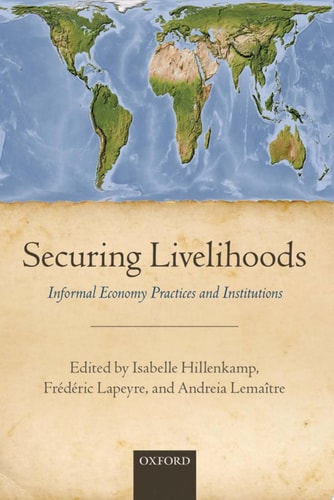
Securing Livelihoods: Informal Economy Practices and Institutions
0
0
As an Amazon Associate and affiliate partner, Menrva Books earns from qualifying purchases. Learn more
Author Description
Far from the vision of popular actors in the popular economy as reactionary and archaic, stubbornly resisting any move towards change, this book's overall aim is to contribute to a broadening and deepening of our understanding of the logic and socio-economic practices of those operating in the informal economy. It focuses on the vulnerabilities of these participants, resulting from high exposure to different risks combined with low social protection, and on the interactions between vulnerability and poverty. It considers security of livelihoods as the guiding principle for multiple practices in the informal economy. Thirteen studies, based on careful analyses of empirical data in different contexts in Africa, Latin America, and Asia, contribute to this multidisciplinary discussion. This book describes how people develop their own strategies to solve their problems through the use of interpersonal networks, associations, and other community-based arrangements. Moreover, it shows that informal economy actors systematically reposition themselves vis-à-vis the State, markets, international, and national policies with the aim of enhancing their economic and social security, and they may do this either individually or collectively. The book emphasizes how adaptability of the informal economy can be influenced by such factors as the macroeconomic context, access to financial, technological, and information resources, infrastructure, social protection schemes, and the institutional environment within which adaptations occur. Case studies stress the need to reformulate questions relating to policy intervention based on a more thorough understanding of the perspective of informal economy actors.
Menrva's Summary
THE THESIS
This book investigates the logic and socio-economic practices of informal economy actors to determine how they navigate vulnerability and pursue livelihood security. The authors, Andreia Lemaitre, Frederic Lapeyre, and Isabelle Hillenkamp, utilize a multidisciplinary framework to analyze how individuals and groups interact with state institutions and markets. By synthesizing empirical data from diverse global contexts, the text argues that informal economic activity is a strategic, adaptive response to risk rather than a static or archaic phenomenon.
THE SCOPE MAP
What You Will Find
- Empirical case studies from Africa, Latin America, and Asia
- Analysis of interpersonal networks and community-based arrangements
- Examination of the interaction between macroeconomic policy and local adaptability
- Evaluation of social protection schemes and institutional environments
Scope Limits
- Does not provide a singular universal policy solution for all informal sectors
- Does not focus on formal sector corporate economic theory
THE AUTHORITY PERSPECTIVE
Experts identify this work as a significant contribution to development studies for its focus on the agency of informal economy participants. Readers frequently note the academic density of the prose and the value of the comparative regional analysis provided by the thirteen studies.
Page Count:
352
Publication Date:
2013-01-01
Publisher:
OUP Oxford
ISBN-10:
0191510653
ISBN-13:
9780191510656
Economics
Sociology
Global Studies
Informal Sector Economics
Social policy
Developing Countries
Community Tags
Similar Books