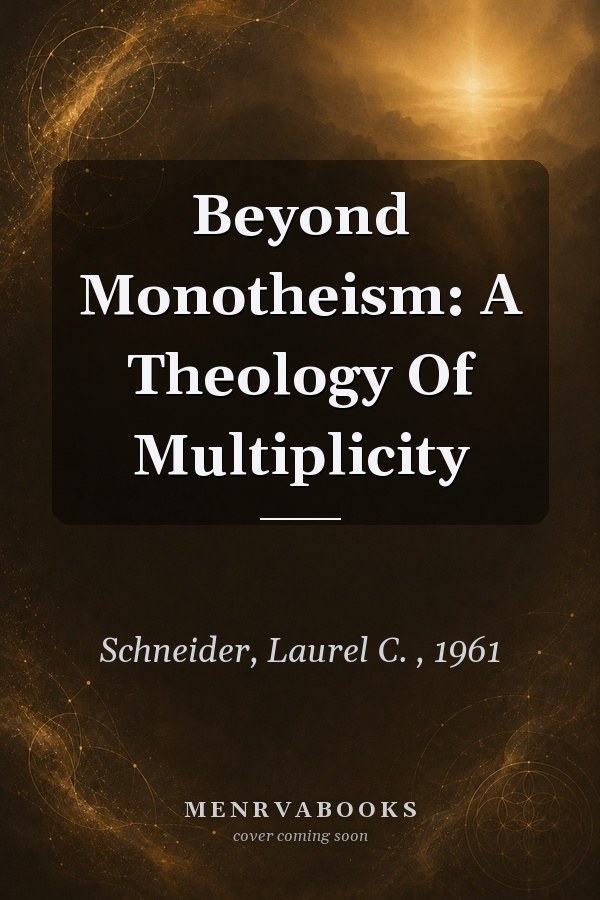
Beyond Monotheism: A Theology of Multiplicity
0
0
As an Amazon Associate and affiliate partner, Menrva Books earns from qualifying purchases. Learn more
Author Description
Laurel Schneider Takes The Reader On A Vivid Journey From The Origins Of The Logic Of The One - Only Recently Dubbed Monotheism - Through To The Modern Day, Where Monotheism Has Increasingly Failed To Adequately Address Spiritual, Scientific, And Ethical Experiences In The Changing World. In Part I, Schneider Traces A Trajectory From The Ancient History Of Monotheism And Multiplicity In Greece, Israel, And Africa Through The Constantinian Valorization Of The Logic Of The One, To Medieval And Modern Challenges To That Logic In Poetry And Science. She Pursues An Alternative And Constructive Approach In Part Ii: A Logic Of Multiplicity Already Resident In Christian Traditions In Which The Complexity Of Life And The Presence Of God May Be Better Articulated. Part Iii Takes Up The Open-ended Question Of Ethics From Within That Multiplicity, Exploring The Implications Of This Radical And Realistic New Theology For The Questions That Lie Underneath Theological Construction: Questions Of Belonging And Nationalism, Of The Possibility Of Love, And Of Unity. In This Groundbreaking Work Of Contemporary Theology, Schneider Shows That The One Is Not Lost In Divine Multiplicity, And That In Spite Of Its Abstractions, Divine Multiplicity Is Realistic And Worldly, Impossible Ultimately To Abstract.
Menrva's Summary
THE THESIS
This work investigates the limitations of monotheistic logic in contemporary spiritual, scientific, and ethical contexts by proposing a theology of multiplicity. Laurel C. Schneider, a scholar of religion and theology, utilizes historical analysis and constructive theological inquiry to challenge the traditional emphasis on divine unity. By examining the historical trajectory of the 'Logic of the One,' she argues that a shift toward multiplicity better accounts for the complexity of human experience and the nature of the divine.
THE SCOPE MAP
What You Will Find
- Historical analysis of monotheism in Greece, Israel, and Africa.
- Examination of the Constantinian influence on theological logic.
- Constructive theological framework for divine multiplicity within Christian traditions.
- Ethical implications regarding nationalism, love, and unity in a pluralistic world.
THE AUTHORITY PERSPECTIVE
Scholars and theologians identify this text as a significant contribution to post-modern theological discourse. Readers frequently note the academic density of the prose, which requires a foundational understanding of historical and systematic theology to fully engage with the author's arguments.
Page Count:
248
Publication Date:
2007-01-01
Publisher:
Routledge
ISBN-10:
0203944712
ISBN-13:
9780203944714
Religion
Philosophy
God
Theology
Monotheism
Christianity
Ethics
Polytheism
Community Tags
Similar Books