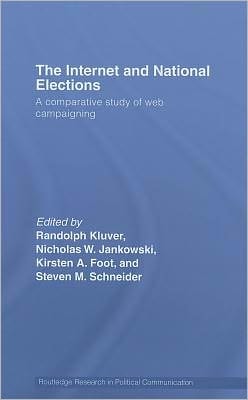
Internet and National Elections: A Comparative Study of Web Campaigning
0
0
As an Amazon Associate and affiliate partner, Menrva Books earns from qualifying purchases. Learn more
Author Description
This volume provides a comparative analysis of the use of the World Wide Web in countries around the world for political campaign purposes.Drawing upon a common conceptual framework - the ‘Web sphere,’ and a shared methodological approach called Web feature analysis - in order to examine how the Internet is used by a variety of political actors during periods of electoral activity. Research teams around the world conducted analyses in technologically advanced nations, as well as those with low Internet diffusion, and a variety of countries in the middle range of network penetration, and from a variety of political and cultural contexts. The book represents an important contribution towards gaining a cross-national understanding of the current and emerging impacts of the Internet on political practice. To that end, the contributors collect and analyze data related to the structure for political action and information provision. They examine twelve types of political actors engaged in elections, including candidates, parties, non-governmental organizations, government, media and individual citizens.Exploring the complex dynamics between politics, culture, and information technology at both the national and global levels, The Internet and National Elections will be of interest to students and researchers of political science, communication studies, international relations, media and Internet studies.
Menrva's Summary
THE THESIS
This volume investigates how the World Wide Web is utilized by diverse political actors to influence national electoral processes across varying cultural and technological landscapes. The authors, a collaborative team of researchers, employ a unified conceptual framework known as the 'Web sphere' and a standardized methodology called Web feature analysis. By examining political activity in nations with differing levels of Internet penetration, the book argues that the digital environment fundamentally alters the structure of political communication and information provision during election cycles.
THE SCOPE MAP
What You Will Find
- A comparative analysis of web campaigning across multiple nations with varying levels of technological infrastructure.
- Application of the 'Web sphere' conceptual framework to evaluate digital political engagement.
- Systematic Web feature analysis methodology used to categorize and measure online political activity.
- Examination of twelve distinct political actor types, including candidates, parties, NGOs, government entities, media organizations, and individual citizens.
THE AUTHORITY PERSPECTIVE
Experts identify this work as a foundational comparative study for understanding the intersection of digital technology and electoral politics. Readers frequently note the academic rigor of the methodology, which provides a structured approach for analyzing cross-national political communication patterns.
Page Count:
304
Publication Date:
2007-01-01
Publisher:
Taylor & Francis Group
ISBN-10:
0203961927
ISBN-13:
9780203961926
International relations
Sociology
Communication Studies
Community Tags
Similar Books