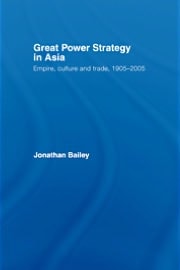
Great Power Strategy in Asia: Empire, Culture and Trade, 1905-2005
0
0
As an Amazon Associate and affiliate partner, Menrva Books earns from qualifying purchases. Learn more
Author Description
Great Power Strategy in Asia, 1905-2005 analyzes the enduring themes underlying the strategic struggles in East Asia, beginning with the crucial event of the 1904-5 Russo-Japanese War.Jonathan Bailey clearly shows why military history is highly relevant in understanding today’s strategic problems, and how the most important areas of current affairs have their roots in often forgotten corners of military history. He makes his powerful case in three clear sections: an analysis of the explosive factors that led to war between Russia and Japan in 1904, presenting a ten-year perspective of the War, focusing on its consequences: cultural shock in ‘the West’, re-alignment of Asian imperial geography and the failure to learn vital military lessons, as World War I approached a thirty-five year perspective of the war, showing why Japan repeated the essential strategic, operational and tactical ploys of its war against Russia in 1904 in its strike upon the USA in 1941. Allied victory assured the downfall of Europe’s empires in Asia, with the USA inheriting much of the old imperial legacy a centennial view of the Russo-Japanese War, which demonstrates that many of the broader issues identifiable in 1904-05 remain at the heart of today’s strategic discourse: Western apprehension about the economic rise of Japan; the anomalies of an ‘American Empire’; tensions between Occident and Orient; the apparent new relevance of geopolitics; and the importance of demography in perceptions of global power. This book is multidisciplinary, emphasizing the linkages between imperial power-politics, military operations, cultural conflict and commercial rivalry. It is also the story of military innovation, the pathology of learning lessons from the experience of war, and the anticipated rise of Asian, or more specifically Chinese, power a century after the false dawn of the Japanese victory in 1905.This book will be of great interest to all students of the Russo-Japanese War, Asian security, and
Menrva's Summary
THE THESIS
This work investigates how the strategic patterns established during the Russo-Japanese War of 1904-1905 continue to dictate the geopolitical landscape of East Asia a century later. Jonathan Bailey, a military historian, utilizes a century of archival data and operational analysis to argue that modern strategic problems in Asia are not isolated events but are deeply rooted in historical precedents of imperial power, cultural friction, and commercial rivalry. He constructs a framework that links military innovation and the failure to learn from past conflicts to the current rise of regional powers like China.
THE SCOPE MAP
What You Will Find
- A detailed analysis of the Russo-Japanese War and its long-term consequences on Asian imperial geography.
- A comparative study of Japanese military tactics in 1904 and 1941 to illustrate strategic continuity.
- An examination of the decline of European empires in Asia and the subsequent shift toward American influence.
- A multidisciplinary framework connecting military operations, cultural conflict, and economic power dynamics.
THE AUTHORITY PERSPECTIVE
Experts and scholars of Asian security frequently cite this text for its ability to bridge the gap between historical military analysis and contemporary geopolitical discourse. Readers often note the academic density of the prose, which provides a rigorous foundation for understanding the enduring tensions between Western and Asian powers.
Page Count:
224
Publication Date:
2006-01-01
Publisher:
Taylor & Francis Group
ISBN-10:
0203969413
ISBN-13:
9780203969410
History
Asian Studies
Strategic aspects
History Military
Military History
International relations
Geopolitics
Community Tags
Similar Books