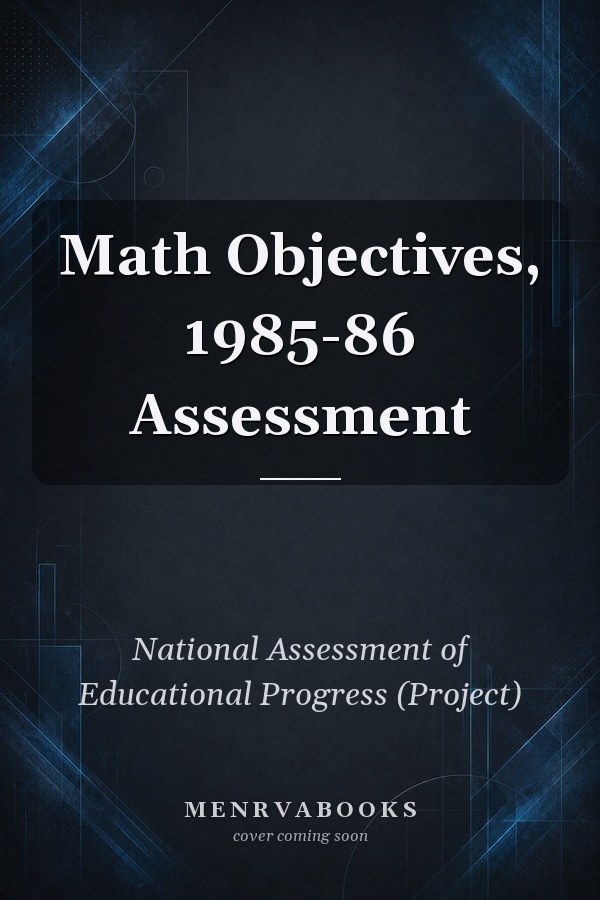
Math Objectives, 1985-86 Assessment
0
0
As an Amazon Associate and affiliate partner, Menrva Books earns from qualifying purchases. Learn more
Author Description
The National Assessment of Educational Progress (naep) collected data on the mathematics performance of 9-, 13-, and 17-year old Americans in 1973, 1978, and 1982. An additional assessment in grades 3, 7, and 11 is planned for 1986. Educational objectives to be used in the 1986 assessment were contributed, reviewed, and revised by a committee of educators. Emphasis was placed on higher-level, critical thinking skills. The objectives were grouped into the following categories, which are described in this document: (1) processes-routine application; understanding; problem solving and reasoning; skills; and knowledge; (2) content-fundamental methods; discreet mathematics; data organization and interpretation; measurement; geometry; relations; functions; and algebraic expressions; and numbers and objectives; and (3) attitudes--mathematics in school; mathematics and oneself; mathematics and society; mathematics as a discipline; and attitudes toward computers. Objectives in five categories concerning the use of calculators are also illustrated: routine computations; more difficult computations; understanding concepts; exploration; and applications and problem solving. (Gdc).
Menrva's Summary
THE THESIS
This document outlines the educational objectives for the 1986 National Assessment of Educational Progress (NAEP) in mathematics. It details the categories and subcategories of mathematical skills, knowledge, and attitudes that were to be assessed, building upon previous NAEP data collected in 1973, 1978, and 1982. The objectives were developed by a committee of educators with a specific emphasis on higher-level, critical thinking skills, reflecting a deliberate effort to move beyond routine applications.
THE SCOPE MAP
- Processes: Routine application, understanding, problem solving and reasoning, skills, and knowledge.
- Content: Fundamental methods, discrete mathematics, data organization and interpretation, measurement, geometry, relations, functions, algebraic expressions, and numbers and objectives.
- Attitudes: Mathematics in school, mathematics and oneself, mathematics and society, mathematics as a discipline, and attitudes toward computers.
- Calculator Use Objectives: Routine computations, more difficult computations, understanding concepts, exploration, and applications and problem solving.
THE AUTHORITY PERSPECTIVE
This document serves as a foundational report detailing the specific learning objectives for a significant national mathematics assessment. Its value lies in its comprehensive categorization of mathematical domains and skills, providing a clear framework for educators and researchers involved in curriculum development and educational measurement. The emphasis on critical thinking and the inclusion of calculator use objectives highlight the evolving pedagogical approaches in mathematics education during the 1980s.
Page Count:
26
Publication Date:
1990-01-01
Publisher:
National Assessment of Educational Progress
ISBN-10:
0886850509
ISBN-13:
9780886850500
Non-Fiction
Assessment
Mathematics
Education
Curriculum
Community Tags
Similar Books