Revisiting Japan's External Adjustment Since 1985
0
0
As an Amazon Associate and affiliate partner, Menrva Books earns from qualifying purchases. Learn more
Author Description
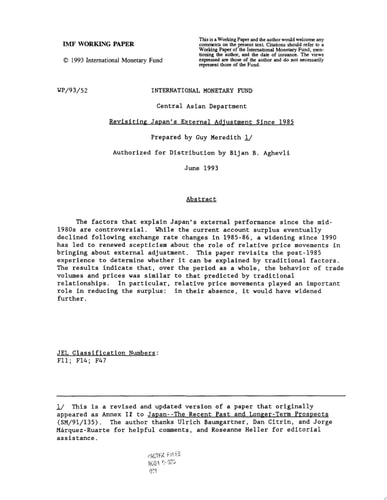
The factors that explain Japan’s external performance since the mid-1980s are controversial. While the current account surplus eventually declined following exchange rate changes in 1985-86, a widening since 1990 has led to renewed scepticism about the role of relative price movements in bringing about external adjustment. This paper revisits the post-1985 experience to determine whether it can be explained by traditional factors. The results indicate that, over the period as a whole, the behavior of trade volumes and prices was similar to that predicted by traditional relationships. In particular, relative price movements played an important role in reducing the surplus: in their absence, it would have widened further.
Menrva's Summary
THE THESIS
This paper investigates the controversial factors influencing Japan's external adjustment since the mid-1980s. The author revisits the post-1985 experience to determine if traditional economic factors can explain the observed trends in Japan's current account surplus. The analysis focuses on the interplay of exchange rate changes, trade volumes, and price movements, challenging renewed skepticism about the role of relative price adjustments.
THE SCOPE MAP
- Analysis of Japan's current account surplus trends from 1985 onwards.
- Examination of the impact of exchange rate changes in 1985-86.
- Investigation into the widening of the surplus since 1990 and its causes.
- Assessment of the role of relative price movements in external adjustment.
- Comparison of actual trade volumes and prices with traditional economic predictions.
- Determination of whether traditional factors adequately explain Japan's external performance.
THE AUTHORITY PERSPECTIVE
The paper revisits the post-1985 experience of Japan's external adjustment, aiming to clarify the factors behind its current account surplus. It indicates that traditional economic relationships, particularly relative price movements, played a significant role in reducing the surplus. Without these movements, the surplus would have likely widened further. The findings suggest that traditional factors provide a valid explanation for Japan's external performance over the period studied.
Page Count:
26
Publication Date:
1993-06-01
Publisher:
International Monetary Fund
ISBN-10:
1451847173
ISBN-13:
9781451847178
Non-Fiction
Economics
History
International Trade
Community Tags
Similar Books