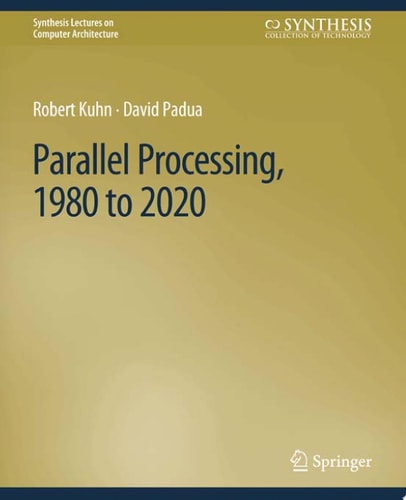
Parallel Processing, 1980 to 2020
0
0
As an Amazon Associate and affiliate partner, Menrva Books earns from qualifying purchases. Learn more
Author Description
This historical survey of parallel processing from 1980 to 2020 is a follow-up to the authors’ 1981 Tutorial on Parallel Processing, which covered the state of the art in hardware, programming languages, and applications. Here, we cover the evolution of the field since 1980 in: parallel computers, ranging from the Cyber 205 to clusters now approaching an exaflop, to multicore microprocessors, and Graphic Processing Units (GPUs) in commodity personal devices; parallel programming notations such as OpenMP, MPI message passing, and CUDA streaming notation; and seven parallel applications, such as finite element analysis and computer vision. Some things that looked like they would be major trends in 1981, such as big Single Instruction Multiple Data arrays disappeared for some time but have been revived recently in deep neural network processors. There are now major trends that did not exist in 1980, such as GPUs, distributed memory machines, and parallel processing in nearly every commodity device. This book is intended for those that already have some knowledge of parallel processing today and want to learn about the history of the three areas. In parallel hardware, every major parallel architecture type from 1980 has scaled-up in performance and scaled-out into commodity microprocessors and GPUs, so that every personal and embedded device is a parallel processor. There has been a confluence of parallel architecture types into hybrid parallel systems. Much of the impetus for change has been Moore’s Law, but as clock speed increases have stopped and feature size decreases have slowed down, there has been increased demand on parallel processing to continue performance gains. In programming notations and compilers, we observe that the roots of today’s programming notations existed before 1980. And that, through a great deal of research, the most widely used programming notations today, although the result of much broadening of these roots, remain close to target system a
Menrva's Summary
THE THESIS
This book surveys the evolution of parallel processing from 1980 to 2020, detailing advancements in hardware, programming notations, and applications. Building on the authors' previous work, this historical account traces the trajectory of parallel computers from early supercomputers to modern exaflop clusters, multicore microprocessors, and GPUs. It examines the development of parallel programming paradigms like OpenMP, MPI, and CUDA, alongside their application in fields such as finite element analysis and computer vision. The text highlights how trends like Single Instruction Multiple Data (SIMD) arrays have resurfaced and how new paradigms like GPUs and distributed memory machines have emerged, fundamentally altering the landscape of computing.
THE SCOPE MAP
- The evolution of parallel computer architectures, from the Cyber 205 to contemporary exaflop clusters, multicore microprocessors, and GPUs.
- Key parallel programming notations including OpenMP, MPI message passing, and CUDA streaming notation.
- A review of seven parallel applications, such as finite element analysis and computer vision.
- Analysis of historical trends in parallel processing, including the resurgence of SIMD arrays in deep neural network processors.
- Discussion of emergent trends not present in 1980, such as GPUs and distributed memory machines.
- The impact of Moore's Law and the shift towards parallel processing for continued performance gains as clock speed increases plateau.
- The relationship between historical programming notations and modern widely-used systems.
THE AUTHORITY PERSPECTIVE
This book is intended for individuals with existing knowledge of parallel processing who wish to understand its historical development. It details the scaling and integration of parallel architectures into commodity devices and the convergence into hybrid systems. The authors emphasize the ongoing demand for parallel processing to drive performance gains, particularly as Moore's Law's traditional drivers slow. The text also explores the evolution of programming notations, showing how early concepts have broadened into today's widely adopted systems.
Page Count:
166
Publication Date:
2022-05-31
Publisher:
Springer Nature
ISBN-10:
3031017684
ISBN-13:
9783031017681
Science & Technology
History
Non-Fiction
Computer Science
Computer Architecture
Community Tags
Similar Books