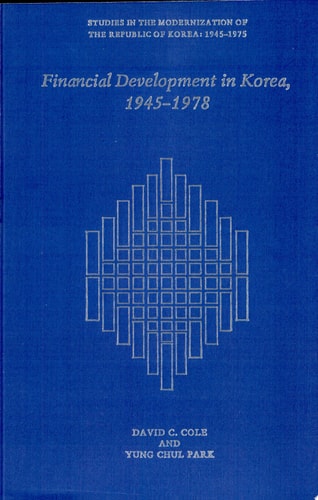
Financial Development in Korea, 1945-1978
0
0
As an Amazon Associate and affiliate partner, Menrva Books earns from qualifying purchases. Learn more
Author Description
This ninth title in the series Studies in the Modernization of the Republic of Korea offers new insights into the role of finance in a rapidly developing country. Combining history and theory, it provides a rigorous test of previous theoretical propositions. The study illustrates the complexity of the Korean financial system and the danger of easy generalization from partial evidence. The two major components of the financial system are brought into focus--one regulated and statistically recorded, the other unregulated, unrecorded. The burden of financial intermediation shifts from one to the other largely in response to government policy measures. By looking only at the regulated sector, previous studies have often misperceived the role of the financial system and the effects of government policies. The financial scandal in Seoul in May 1982 vividly demonstrated that the unregulated part of the system is still important and that overregulation of the "modern" part generates strong pressures for perpetuating the illegal, unregulated, "traditional" financial institutions.
Menrva's Summary
THE THESIS
This book investigates the complex and often contradictory role of financial development in South Korea's rapid economic growth between 1945 and 1978. Authors David Chamberlin Cole and Yung Chul Park, drawing on their expertise in economics and finance, present a rigorous analysis that challenges previous theoretical assumptions about financial systems in developing nations. Their work highlights the critical distinction between regulated and unregulated financial sectors, demonstrating how government policies influence the flow of capital between them and how focusing solely on the regulated sector can lead to misinterpretations of the financial system's true impact. The study underscores the persistent importance of informal financial institutions, even in the face of overregulation in the formal sector.
THE SCOPE MAP
- Analysis of the regulated financial sector in Korea from 1945-1978.
- Examination of the unregulated, informal financial sector and its dynamics.
- The impact of government policies on financial intermediation.
- A theoretical framework for understanding financial development in rapidly growing economies.
- Case studies illustrating the complexity of the Korean financial system.
- Discussion of the interplay between formal and informal financial institutions.
THE AUTHORITY PERSPECTIVE
This study is recognized for its detailed examination of South Korea's financial history during a pivotal period of economic modernization. By dissecting the dual nature of the Korean financial system—its formal, regulated components and its informal, unregulated counterparts—the authors provide a nuanced understanding of capital flows and the influence of state policy. The work serves as a critical test of existing financial development theories, offering valuable insights for economists and historians studying developing economies and the complexities of financial regulation.
Page Count:
349
Publication Date:
1983-01-01
Publisher:
Harvard Univ Asia Center
ISBN-10:
0674301471
ISBN-13:
9780674301474
Non-Fiction
Economics
History
Finance
Community Tags
Similar Books