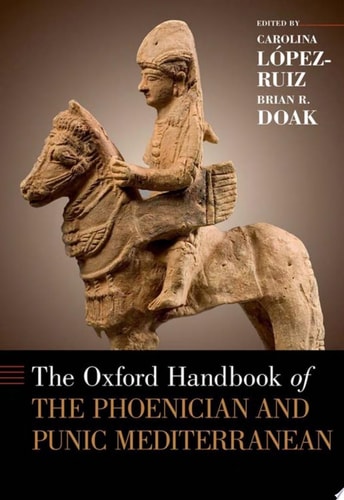
The Oxford Handbook Of The Phoenician And Punic Mediterranean
0
0
As an Amazon Associate and affiliate partner, Menrva Books earns from qualifying purchases. Learn more
Author Description
The Phoenicians created the Mediterranean world as we know it-yet they remain a shadowy and poorly understood group. The academic study of the Phoenicians has come to an important crossroads; the field has grown in sheer content, sophistication of analysis, and diversity of interpretation, and we now need a current overview of where the study of these ancient seafarers and craftsman stands and where it is going. Moreover, the field of Phoenician studies is particularly fragmented and scattered. While there is growing interest in all things Phoenician and Punic, the latest advances are mostly published in specialized journals and conference volumes in a plethora of languages. This handbook is the first of its type to appear in over two decades, and the first ever to appear in English. In these chapters, written by a wide range of prominent and promising scholars from across Europe, North America, Australia, and the Mediterranean world, readers will find summary studies on key historical moments (such as the history of Carthage), areas of culture (organized around language, religion, and material culture), regional studies and areas of contact (spanning from the Levant and the Aegean to Iberia and North Africa), and the reception of the Phoenicians as an idea, entangled with the formation of other cultural identities, both ancient and modern.
Menrva's Summary
THE THESIS
This handbook investigates the current state of Phoenician and Punic studies, addressing the need for a comprehensive, English-language synthesis of a historically fragmented field. Brian R. Doak, a scholar specializing in ancient Near Eastern studies, compiles contributions from an international cohort of experts to consolidate recent advances in archaeology, linguistics, and cultural history. The volume argues that the Phoenicians were central to the development of the Mediterranean world and provides a structured framework for understanding their complex legacy across diverse geographic and temporal contexts.
THE SCOPE MAP
What You Will Find
- Historical analysis of key Phoenician centers, including the development of Carthage.
- Thematic examinations of Phoenician language, religious practices, and material culture.
- Regional studies covering the Levant, the Aegean, Iberia, and North Africa.
- Investigations into the reception and cultural identity of the Phoenicians in both ancient and modern discourse.
Scope Limits
- The text does not provide a singular, unified narrative history but rather a collection of specialized scholarly perspectives.
- It does not attempt to resolve every debate in the field but instead highlights areas of ongoing academic contention.
THE AUTHORITY PERSPECTIVE
Scholars and students of antiquity recognize this volume as a significant reference work that fills a long-standing gap in English-language scholarship. The text is noted for its academic density and its utility as a foundational resource for researchers navigating the complex, multilingual literature of Phoenician studies.
Page Count:
768
Publication Date:
2019-01-01
Publisher:
Oxford University Press
ISBN-10:
0190499354
ISBN-13:
9780190499358
History
Reference
Ancient History
Academic
Archaeology
Community Tags
Similar Books