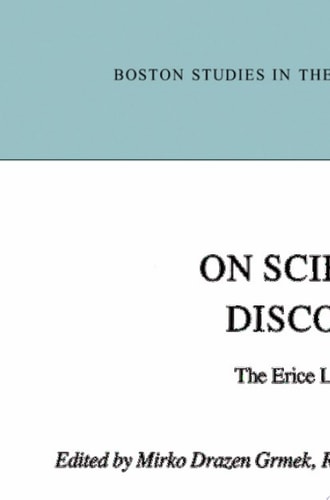
On Scientific Discovery: The Erice Lectures 1977
0
0
As an Amazon Associate and affiliate partner, Menrva Books earns from qualifying purchases. Learn more
Author Description
The 1977 lectures of the International School for the History of Science at Erice in Sicily were devoted to that vexing but inexorable problem, the nature of scientific discovery. With all that has been written, by scientists themselves, by historians and philosophers and social theorists, by psycholo gists and psychiatrists, by logicians and novelists, the problem remains elusive. Happily we are able to bring the penetrating lectures from Erice that summer to a wider audience in this volume of theoretical investigations and detailed case studies. The ancient and lovely town of Erice in Northwest Sicily, 750 m above the sea, was famous throughout the Mediterranean for its temple of the goddess of nature, Venus Erycina, said to have been built by Daedalus. As philosophers and historians of the natural sciences, we hope that the stimulating atmo sphere of Erice will to some extent be transmitted by these pages. We are especially grateful to that generous and humane physician and historian of science, Dr. Vincenzo Cappelletti, himself a creative scientist, for his collaboration in bringing this work to completion. We admire his intelligent devotion to fostering creative interaction between scientists and historians of science as Director of the School of History of Science within the great Ettore Majorana Centre for Scientific Culture at Erice, as well as for his imaginative leadership of the Istituto della Encic10pedia Italiana.
Menrva's Summary
THE THESIS
This volume investigates the elusive nature of scientific discovery through lectures delivered at the International School for the History of Science in 1977. The book brings together theoretical investigations and detailed case studies from leading figures in the history and philosophy of science, aiming to illuminate a problem that has long defied simple explanation despite extensive scholarly attention. The lectures were held in Erice, Sicily, a town with a rich historical and cultural background, and the editors hope to convey some of the stimulating atmosphere of that location. The work is a collaborative effort, with contributions from scientists, historians, philosophers, and social theorists, all contributing to a multifaceted exploration of how scientific breakthroughs occur.
THE SCOPE MAP
- Theoretical investigations into the nature of scientific discovery.
- Detailed case studies illustrating scientific breakthroughs.
- Contributions from historians, philosophers, and scientists.
- Exploration of the interdisciplinary aspects of scientific progress.
THE AUTHORITY PERSPECTIVE
The lectures presented in this volume offer a deep dive into the complex topic of scientific discovery, drawing on a range of perspectives from the history and philosophy of science. The collection aims to provide a comprehensive overview of the problem, incorporating both theoretical frameworks and practical examples. The setting of Erice, Sicily, is noted for its historical significance, and the editors express a hope that this ambiance contributes to the intellectual engagement of the reader. The book serves as a valuable resource for those interested in understanding the processes and challenges inherent in scientific advancement.
Page Count:
336
Publication Date:
2012-12-06
Publisher:
Springer Science & Business Media
ISBN-10:
9401012849
ISBN-13:
9789401012843
History
Philosophy
Non-Fiction
Scientific Discovery
Case studies
Community Tags
Other Editions(2)

Similar Books