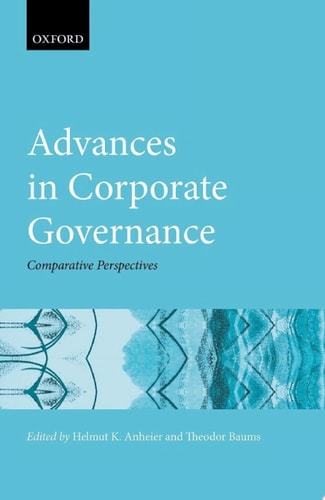
Advances in Corporate Governance: Comparative Perspectives
0
0
As an Amazon Associate and affiliate partner, Menrva Books earns from qualifying purchases. Learn more
Author Description
The governance of the modern corporation is broadly understood as the mechanisms, relations, and processes for balancing the interests of stakeholders. It spells out the rules and procedures for decision-making, accountability and transparency, and distributional rights. Corporate governance thus provides the framework in which corporate objectives are set, the means of attaining them, the kind of performance monitoring required, and by whom. In the aftermath of the global financial crisis and large-scale corporate failures, the issue of corporate governance has repeatedly received the attention of policy-makers and the wider public. Extending the study of corporate governance beyond that of listed corporations sheds new light on the overall performance of corporations in market economies. These include small to medium-sized corporations, nonprofit organisations and philanthropic foundations, public corporations and public-private partnerships, social enterprises and cooperatives, international organisations, and corporations in cyberspace. A decade after the massive failures in the governance of financial corporations, and with continued governance failures in other parts of the economy since then, this volume takes stock and asks: what has been the performance of corporate governance regimes, and have regulatory changes and corporate governance codes made a difference? What are the strengths and weaknesses of current corporate governance systems and codes? How do corporate forms differ in their governance performance, and what have been the experiences across countries? And, finally, what implications for understanding governance behaviour and for policy-makers and regulators come to mind?
Menrva's Summary
THE THESIS
This volume investigates the efficacy of contemporary corporate governance regimes and regulatory frameworks in the wake of recurring global financial and organizational failures. Editors Helmut Anheier and Theodor Baums, both established scholars in governance and law, compile expert analysis to assess how diverse corporate structures—ranging from small enterprises to international organizations—perform under current accountability and transparency standards. The text evaluates whether recent regulatory shifts have successfully mitigated systemic risks or if fundamental weaknesses persist within global governance systems.
THE SCOPE MAP
What You Will Find
- Comparative analysis of governance performance across different corporate forms including nonprofits, social enterprises, and public-private partnerships.
- Evaluation of the impact of post-financial crisis regulatory changes and governance codes.
- Cross-national studies examining the practical application of governance procedures.
Scope Limits
- The text does not provide a prescriptive manual for individual corporate compliance officers.
- It does not focus on the internal management strategies of specific private firms, but rather on systemic and structural governance frameworks.
THE AUTHORITY PERSPECTIVE
Experts identify this report as a significant contribution to the comparative study of institutional governance beyond the traditional listed-company model. Readers frequently note the academic density of the prose, which serves as a rigorous resource for policy-makers and researchers interested in the intersection of law, economics, and organizational behavior.
Page Count:
324
Publication Date:
2020-01-01
Publisher:
OUP Oxford
ISBN-10:
0192636200
ISBN-13:
9780192636201
Economics
Business
Public Administration
Finance
Corporate governance
Management
Public Policy
Community Tags
Similar Books