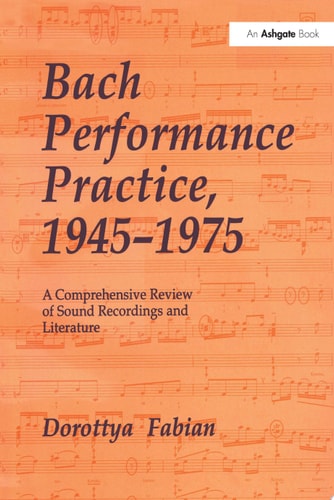
Bach Performance Practice, 1945–1975
0
0
As an Amazon Associate and affiliate partner, Menrva Books earns from qualifying purchases. Learn more
Author Description
Analysing over 100 recordings from 1945-1975, this book examines twentieth-century baroque performance practice as evinced in all the commercially available recordings of J.S. Bach's Passions, Brandenburg Concertos and Goldberg Variations. Dorottya Fabian presents a qualitative, style-orientated history of the early music movement in its formative years through a comparison of the performance style heard in these recordings with the scholarly literature on Bach performance practice. Issues explored in the book include the availability of resources, balance, tempo, dynamics, ornamentation, rhythm and articulation. During the decades following the Second World War, the early music movement was more concerned with the revival of repertoire than with the revival of performance style which meant that its characteristics and achievements differed essentially from those of the later 1970s and 1980s. Period practice techniques were not practised even by ensembles using eighteenth-century instruments. Yet, as this survey reveals, several recordings of the period provide unexpectedly stylish interpretations using metre and pulse to punctuate the music. Such metric performance and appropriate articulation helped to clarify structure and texture and assisted in the creation of a musical discourse - the pre-eminent goal of baroque compositions.
Menrva's Summary
THE THESIS
This book investigates the evolution of Baroque performance practice in the mid-twentieth century through an analysis of J.S. Bach recordings. Dorottya Fabian examines over 100 recordings of Bach's Passions, Brandenburg Concertos, and Goldberg Variations made between 1945 and 1975. The study compares the performance styles found in these recordings with contemporary scholarly literature on Bach performance practice, offering a style-oriented history of the early music movement's formative years. It explores how, despite a primary focus on repertoire revival rather than authentic performance style, certain recordings from this era presented surprisingly stylish interpretations that clarified musical structure and texture.
THE SCOPE MAP
- Analysis of over 100 commercial recordings of J.S. Bach's Passions, Brandenburg Concertos, and Goldberg Variations from 1945-1975.
- Comparison of recorded performance styles with scholarly literature on Bach performance practice.
- Exploration of issues such as resource availability, balance, tempo, dynamics, ornamentation, rhythm, and articulation.
- Historical context of the early music movement's focus on repertoire revival over performance style revival in the post-WWII decades.
- Discussion of how period practice techniques were not consistently applied, even by ensembles using period instruments.
- Identification of recordings that offered stylish interpretations through effective use of metre, pulse, and articulation.
- Argument for how metric performance and appropriate articulation contributed to clarifying musical structure and texture.
- Examination of the pre-eminent goal of baroque compositions: the creation of a clear musical discourse.
THE AUTHORITY PERSPECTIVE
The book provides a detailed, style-oriented history of the early music movement during a crucial period of its development. By comparing actual recordings with theoretical scholarship, it offers insights into the performance practices of the mid-twentieth century. The analysis highlights how, even without strict adherence to period techniques, certain recordings achieved a clarity and musical discourse characteristic of Baroque compositions. This work is valuable for understanding the historical trajectory of early music performance and its scholarly underpinnings.
Page Count:
328
Publication Date:
2017-07-05
Publisher:
Taylor & Francis
ISBN-10:
1351574876
ISBN-13:
9781351574877
History
Music
Baroque Music
Musicology
Music History
Community Tags
Similar Books