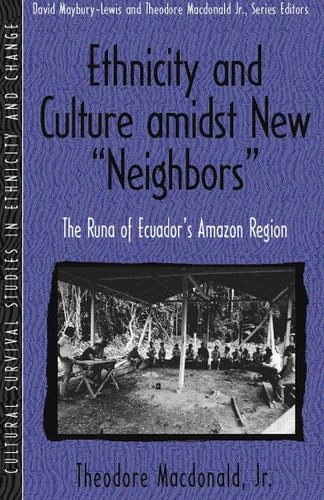
Ethnicity and Culture Amidst New Neighbors: The Runa of Ecuador's Amazon Region
0
0
As an Amazon Associate and affiliate partner, Menrva Books earns from qualifying purchases. Learn more
Author Description
This book provides the reader with a story that has been many years in the making. It is the story of the Runa, a Quichua-speaking Indian population in Ecuador's Amazon region. It offers a window onto another culture, an illustration of the relationship between ethnicity and culture, and a story of the mobilization of an indigenous group. And when the reader arrives at the book's end, he or she will understand why the story is not merely shelved and finished, but is rather an ongoing tale that will continue for years to come. The author has been following the Runa's adaptation to continuous changes around and amongst them since 1974. When he first met the Runa, they were practicing swidden horticulture, hunting, fishing, and living their created culture while also reacting to external pressures imposed on them by newly arrived colonists and changing national legislation. This book follows the Runa from a passive accommodating society to an active organized group. The Runa thus became one of the early standard bearers in what is now a hemispheric social movement -- indigenous ethnic federations. These organizations have changed Latin America by successfully thrusting indigenous identities and concerns into the middle of national political arenas that previously marginalized and stigmatized them. Anthropologists or anyone interested in other cultures. Part of the New Immigrant's Series.
Menrva's Summary
THE THESIS
How does an indigenous population transition from passive accommodation to active political mobilization in the face of external pressures and national marginalization? Theodore Macdonald Jr. draws upon decades of longitudinal ethnographic research, beginning in 1974, to document the Runa people of the Ecuadorian Amazon. By analyzing their shift from traditional swidden horticulture and subsistence practices to the formation of organized ethnic federations, the author provides a framework for understanding the intersection of cultural identity and political agency in Latin America.
THE SCOPE MAP
What You Will Find
- Longitudinal ethnographic study of the Quichua-speaking Runa population from 1974 through the late 1990s.
- Analysis of the transition from subsistence-based horticulture to organized political activism.
- Examination of the impact of national legislation and colonist encroachment on indigenous social structures.
- Case study of the emergence of indigenous ethnic federations as a hemispheric social movement.
THE AUTHORITY PERSPECTIVE
The text serves as a dense, scholarly examination of indigenous adaptation, likely intended for students and professionals in the fields of anthropology and Latin American studies. Its focus on long-term field observation provides a grounded perspective on the mechanisms of political mobilization within marginalized communities.
Page Count:
176
Publication Date:
1998-06-11
Publisher:
Pearson
ISBN-10:
020519821X
ISBN-13:
9780205198214
Anthropology
Ethnography
Sociology
Community Tags
Similar Books