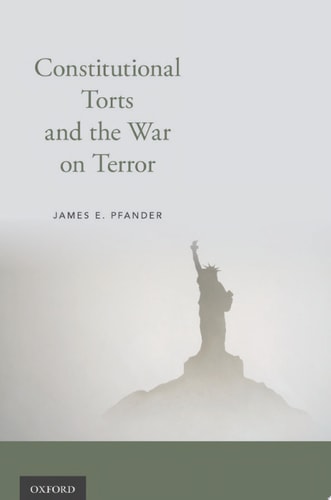
Constitutional Torts and the War on Terror
0
0
As an Amazon Associate and affiliate partner, Menrva Books earns from qualifying purchases. Learn more
Author Description
Constitutional Torts and the War on Terror examines the judicial response to human rights claims arising from the Bush Administration's war on terror. Despite widespread agreement that the Administration's program of extraordinary rendition, prolonged detention, and "enhanced" interrogation was torture by another name, not a single federal appellate court has confirmed an award of damages to the program's victims. The silence of the federal courts leaves victims without redress and the constitutional limits on government action undefined.Many of the suits seeking redress have been based on the landmark 1971 Supreme Court decision in Bivens v. Six Unknown Named Agents of the Federal Bureau of Narcotics. This book traces the history of common law accountability, the rise of Bivens claims, and the post-Bivens history of constitutional tort litigation. After evaluating the failure of Bivens litigation arising from the war on terror, the book considers and rejects the arguments that have been put forward to explain and justify judicial silence.The book provides the Supreme Court with the tools needed to rethink its Bivens jurisprudence. Rather than treating the overseas national security context as disabling, modern federal courts should take a page from the nineteenth century, presume the viability of tort litigation, and proceed to the merits. Only by doing so can the federal courts ensure redress for victims and prevent future Administrations from using torture as an instrument of official policy.
Menrva's Summary
THE THESIS
This book investigates why federal appellate courts have consistently denied damages to victims of the Bush Administration's war on terror programs, despite widespread recognition of human rights abuses. James E. Pfander, a legal scholar, utilizes historical analysis of common law accountability and an evaluation of Bivens v. Six Unknown Named Agents of the Federal Bureau of Narcotics to argue that the judiciary has improperly abdicated its role. He contends that courts should move away from the current trend of judicial silence and instead adopt a presumption of viability for tort litigation to ensure government accountability.
THE SCOPE MAP
What You Will Find
- Historical evolution of common law accountability and constitutional tort litigation
- Analysis of Bivens jurisprudence and its application in national security contexts
- Evaluation of judicial arguments used to justify the dismissal of war on terror claims
Scope Limits
- Does not provide a comprehensive history of all war on terror policies
- Does not offer a definitive legislative solution, focusing instead on judicial reform
THE AUTHORITY PERSPECTIVE
Legal scholars and practitioners frequently cite this work as a critical examination of the intersection between national security and individual rights. Experts highlight the text as a significant contribution to the ongoing debate regarding the scope of judicial oversight in cases involving executive branch actions.
Page Count:
274
Publication Date:
2017-01-18
Publisher:
Oxford University Press
ISBN-10:
0190495286
ISBN-13:
9780190495282
Legal History
United States
Law
Constitutional Law
Terrorism
National security
Human rights
Community Tags
Similar Books