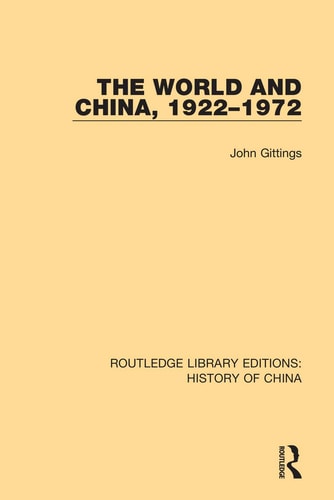
The World and China, 1922-1972
0
0
As an Amazon Associate and affiliate partner, Menrva Books earns from qualifying purchases. Learn more
Author Description
This book, first published in 1974, was the only one to treat China's foreign policy in its entirety, both as the subject of historically documented narrative (before and since the Liberation of 1949) and as the product of ideas themselves requiring analysis. It is also unique in approaching these ideas by the route they took into the Chinese consciousness: for Mao the young Chinese republic was a 'semi-colony' over which the imperialists were falling out. His revolution would float like a boat on top of their 'contradictions'.
Menrva's Summary
THE THESIS
This book investigates the entirety of China's foreign policy from 1922 to 1972, examining both its historical narrative and the underlying ideas that shaped it. John Gittings, an established author in the field, draws upon historical documentation and analytical frameworks to explore how foreign policy concepts entered the Chinese consciousness. The central argument posits that China's foreign policy, particularly under Mao, was significantly influenced by its perception of imperialist rivalries and internal 'contradictions.' This work uniquely traces the evolution of these ideas as they were integrated into China's revolutionary and post-revolutionary strategies.
THE SCOPE MAP
- Historical narrative of China's foreign policy from 1922 to 1972.
- Analysis of the ideas and concepts that informed China's foreign policy.
- Exploration of how foreign policy ideas entered the Chinese consciousness, particularly Mao's.
- Examination of China's position as a 'semi-colony' and its strategic responses to imperialist powers.
THE AUTHORITY PERSPECTIVE
This book is regarded as a singular and comprehensive treatment of China's foreign policy during a pivotal half-century. Its unique approach, analyzing both the historical events and the ideological underpinnings, has made it a valuable resource for understanding the period. The work is noted for tracing the intellectual routes through which foreign policy concepts were adopted and adapted within China. Its enduring relevance lies in its detailed examination of the forces that shaped China's international outlook.
Page Count:
306
Publication Date:
2019-12-16
Publisher:
Taylor & Francis Group
ISBN-10:
1138614653
ISBN-13:
9781138614659
History
Non-Fiction
International relations
Community Tags
Similar Books