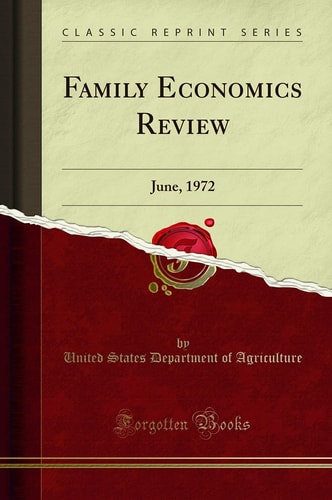
Family Economics Review June, 1972 (Classic Reprint)
0
0
As an Amazon Associate and affiliate partner, Menrva Books earns from qualifying purchases. Learn more
Author Description
Excerpt from Family Economics Review: June, 1972 Slightly more than half of the 1, 700 Shoppers contacted said they were aware of the chain's open - dating program. Of the 429 Shoppers interviewed in depth, about two-thirds said that they had used the date information at least once. Five item groups(bread, milk, refrigerated dough products, other dairy products, and eggs) accounted for 70 percent of all uses of the open dates. When shoppers were asked what the date told them about a product, their answers varied widely. Only 20 percent correctly interpreted the date as the last day of sale. Forty-five percent said the date represented some time in the past-for example, date of manufacture, packaging, delivery, or display. Twenty-two percent said that the date indicated the end of the product's usable life-a misinterpretation that could lead to a lot of perfectly good food being wasted if consumers followed through on it. Perhaps the most important group of answers came from 38 percent of the Shoppers - they said quite simply that the date tells either how fresh an item is or just that it is fresh. From the variety of answers given and the frequency of answers involving past dates, obviously Shoppers do not look carefully at the dates on the items they purchase. The Shoppers' lack of concern about the precise meaning of codes or dates was con firmed by their lack of interest in the code book. Only nine of the 429 women inter viewed in depth had ever used the code book. If a Shopper mentioned having used date information for a Specific time, she was asked specific questions about it. Only for refrigerated dough products was there any substantial agreement among Shoppers as to the meaning of the date. These pro ducts, unlike most of those included in the open-dating program, have been marked with a readable date for years. For most items, the manufacturer has also included some storage instructions and a statement that, for best results, the item Should be Stored
Menrva's Summary
THE THESIS
This excerpt investigates consumer understanding and utilization of open-dating programs on food products in 1972. The study, based on interviews with 1,700 shoppers, reveals a significant gap between the intended purpose of dating and consumer interpretation. While some shoppers correctly identified dates as the last day of sale, a substantial portion misinterpreted them as past dates or indicators of freshness, leading to potential food waste. The research highlights a general lack of shopper attention to date codes and a low interest in accompanying code books, suggesting a need for clearer communication and education regarding food dating practices.
THE SCOPE MAP
- Analysis of shopper awareness and usage of open-dating programs on food products.
- Categorization of shopper interpretations of date codes, including correct and incorrect understandings.
- Identification of specific food item groups (bread, milk, refrigerated dough, dairy, eggs) most affected by date usage.
- Examination of the correlation between shopper understanding of dates and their interest in code books.
- Case study of refrigerated dough products, which had historically used readable dates.
- Discussion of manufacturer-provided storage instructions and their relation to date codes.
THE AUTHORITY PERSPECTIVE
This historical analysis of consumer behavior regarding food dating in 1972 offers a snapshot of shopper understanding at a specific point in time. The data presented suggests that, even decades ago, there was a notable disconnect between industry practices and consumer comprehension of product dating. The findings point to potential inefficiencies in food supply chains and consumer habits that could lead to unnecessary waste. The excerpt serves as a valuable resource for understanding the evolution of consumer awareness in food marketing and safety.
Page Count:
30
Publication Date:
2017-11-06
Publisher:
FB&C Limited
ISBN-10:
026508573X
ISBN-13:
9780265085738
Economics
History
Non-Fiction
Consumer Behavior
Food Industry
Community Tags
Similar Books