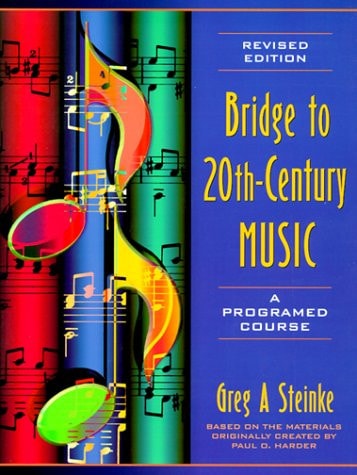
Bridge to Twentieth-Century Music: A Programed Course
0
0
As an Amazon Associate and affiliate partner, Menrva Books earns from qualifying purchases. Learn more
Author Description
This unique book utilizes programmed instruction to help students gain mastery of some concepts and techniques related to late nineteenth and early twentieth century harmony. Programmed instruction provides immediate feedback which speeds the learning process and prevents missed points and wrong ideas from causing serious trouble. Readers receive continual feedback and reinforcement as they work at their own pace. A Discography in an Appendix provides musical examples of issues in the book. This book is divided into three sections: Part 1 is Melodic Tonality; Part 2 is Harmonic Tonality; and Part 3 is The Evolution of Harmonic Tonality. For anyone interested in Music Theory and History.
Menrva's Summary
THE THESIS
This text investigates the core question of how students can achieve mastery over the complex harmonic shifts occurring between the late nineteenth and early twentieth centuries. The authors, Dr. Paul O. Harder and Greg A. Steinke, utilize a structured, programmed instruction methodology designed to facilitate self-paced learning. By integrating immediate feedback loops and specific musical examples, the book provides a systematic framework for understanding the transition from traditional tonality to the evolving harmonic structures of the modern era.
THE SCOPE MAP
What You Will Find
- A three-part instructional framework covering Melodic Tonality, Harmonic Tonality, and The Evolution of Harmonic Tonality.
- A programmed learning methodology that provides immediate feedback to reinforce conceptual understanding.
- A comprehensive discography in the appendix to provide auditory examples of the theoretical issues discussed.
- A technical exploration of harmonic techniques and concepts relevant to the late nineteenth and early twentieth centuries.
THE AUTHORITY PERSPECTIVE
The subject matter points to a specialized, pedagogical text intended for students and instructors of music theory who require a structured approach to modern harmonic evolution. The framing suggests a highly focused, technical resource that prioritizes incremental skill acquisition through a self-correcting study format.
Page Count:
392
Publication Date:
1999-01-21
Publisher:
Pearson
ISBN-10:
0205287581
ISBN-13:
9780205287581
Musicology
Music History
Education
Music theory
Academic
Community Tags
Similar Books