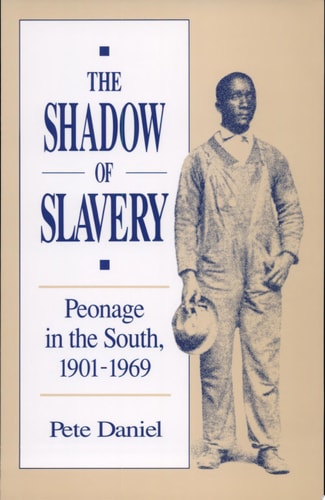
The Shadow of Slavery Peonage in the South, 1901-1969
0
0
As an Amazon Associate and affiliate partner, Menrva Books earns from qualifying purchases. Learn more
Author Description
Whether peonage in the South grew out of slavery, a natural and perhaps unavoidable interlude between bondage and freedom, or whether employers distorted laws and customs to create debt servitude, most Southerners quietly accepted peonage. To the employer it was a way to control laborers; to the peon it was a bewildering system that could not be escaped without risk of imprisonment, beating, or death. Pete Daniel's book is about this largely ignored form of twentieth-century slavery. It is in part "the record of an American failure, the inability of federal, state, and local law-enforcement officers to end peonage." In a series of case studies and histories, Daniel re-creates the neglected and frightening world of peonage, demanding, "If a form of slavery yet exists in the United States, as so much evidence suggests, then the relevant questions are why, and by whose irresponsibility?" Peonage grew out of labor settlements following emancipation, when employers forbade croppers to leave plantations because of debt (often less than $30). At the turn of the century the federal government acknowledged that the "labyrinth of local customs and laws" binding men in debt was peonage. They outlawed debt servitude and slowly moved against it, but with no large success. Disappearing witnesses and acquitted employers characterized the cases that did go to court. Daniel holds that peonage persists for many reasons: the corruption and apathy of law-enforcement, racist traditions in the South, and the impotence of the Justice Department in prosecuting this violation of federal law. He draws extensively on complaints and trial transcripts from the peonage records of the Justice Department.
Menrva's Summary
THE THESIS
This book investigates the persistent and largely ignored system of debt servitude, known as peonage, that flourished in the American South from the end of slavery through the mid-20th century. Pete Daniel examines how employers manipulated laws and customs to create systems of debt bondage, trapping laborers in cycles of servitude that were difficult to escape without severe risk. The book details the failure of federal, state, and local law enforcement to eradicate this form of slavery, highlighting the corruption, apathy, and racist traditions that allowed it to persist.
THE SCOPE MAP
- The historical development of peonage from post-emancipation labor settlements.
- Case studies illustrating the experiences of individuals trapped in debt servitude.
- Analysis of legal and law-enforcement failures in combating peonage.
- Exploration of the role of racism and local customs in perpetuating peonage.
- Extensive use of complaints and trial transcripts from Justice Department records.
- Discussion of the reasons for the continued existence of peonage into the 20th century.
THE AUTHORITY PERSPECTIVE
Pete Daniel's work is recognized for its detailed examination of a critical, yet often overlooked, aspect of American history. The book is noted for its rigorous use of primary source materials, including Justice Department records, to reconstruct the lived experiences of those subjected to peonage. It challenges readers to confront the systemic failures and deeply ingrained prejudices that allowed a form of slavery to persist long after emancipation. The research highlights the inadequacy of legal frameworks and enforcement in addressing widespread human rights abuses.
Page Count:
209
Publication Date:
1972-01-01
Publisher:
University of Illinois Press
ISBN-10:
0252061462
ISBN-13:
9780252061462
History
Non-Fiction
Social History
Law
Community Tags
Similar Books