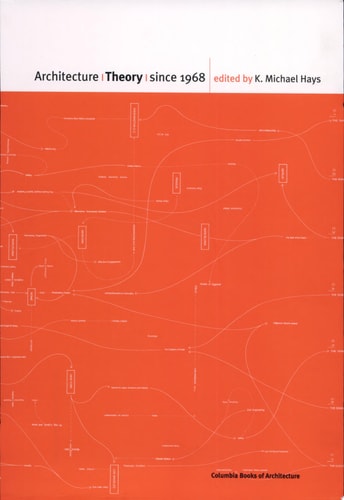
Architecture Theory since 1968
0
0
As an Amazon Associate and affiliate partner, Menrva Books earns from qualifying purchases. Learn more
Author Description
An anthology of the pivotal theoretical texts that have defined architecture culture in the late twentieth century. In the discussion of architecture, there is a prevailing sentiment that, since 1968, cultural production in its traditional sense can no longer be understood to rise spontaneously, as a matter of social course, but must now be constructed through ever more self-conscious theoretical procedures. The development of interpretive modes of various stripes—post-structuralist, Marxian, phenomenological, psychoanalytic, as well as others dissenting or eccentric—has given scholars a range of tools for rethinking architecture in relation to other fields and for reasserting architectures general importance in intellectual discourse. This anthology presents forty-seven of the primary texts of architecture theory, introducing each with an explication of the concepts and categories necessary for its understanding and evaluation. It also presents twelve documents of projects or events that had major theoretical repercussions for the period. Several of the essays appear here in English for the first time. Contributors Diana Agrest, Stanford Anderson, Archizoom, George Baird, Jennifer Bloomer, Massimo Cacciari, Jean-Louis Cohen, Beatriz Colomina, Alan Colquhoun, Maurice Culot, Jacques Derrida, Ignasi de Solá-Morales, Peter Eisenman, Robin Evans, Michel Foucault, Kenneth Frampton, Mario Gandelsonas, Frank Gehry, Jürgen Habermas, John Hejduk, Denis Hollier, Bernard Huet, Catherine Ingraham, Fredric Jameson, Charles A. Jencks, Jeffrey Kipnis, Fred Koetter, Rem Koolhaas, Leon Krier, Sanford Kwinter, Henri Lefebvre, Daniel Libeskind, Mary McLeod, Alberto Pérez-Gómez, José Quetglas, Aldo Rossi, Colin Rowe, Massimo Scolari, Denise Scott Brown, Robert Segrest, Jorge Silvetti, Robert Somol, Martin Steinmann, Robert A. M. Stern, James Stirling, Manfredo Tafuri, Georges Teyssot, Bernard Tschumi, Anthony Vidler, Paul Virilio, Mark Wigley
Menrva's Summary
THE THESIS
This anthology investigates the pivotal theoretical texts that have shaped architectural discourse since 1968. The book addresses the prevailing sentiment that contemporary cultural production, particularly in architecture, is no longer spontaneous but constructed through self-conscious theoretical procedures. It explores how interpretive modes from post-structuralism, Marxism, phenomenology, and psychoanalysis have provided tools for rethinking architecture's relationship to other fields and reasserting its intellectual importance. The anthology presents forty-seven primary texts and twelve documents of projects or events with significant theoretical repercussions, each introduced with an explication of its concepts.
THE SCOPE MAP
- Anthology of pivotal theoretical texts defining architecture culture from 1968 onwards.
- Exploration of self-conscious theoretical procedures in contemporary cultural production.
- Analysis of interpretive modes including post-structuralist, Marxian, phenomenological, and psychoanalytic approaches.
- Re-evaluation of architecture's relationship to other fields and its general importance in intellectual discourse.
- Presentation of forty-seven primary texts of architecture theory.
- Inclusion of twelve documents detailing projects or events with major theoretical repercussions.
- Explication of concepts and categories necessary for understanding and evaluating each text.
- Inclusion of essays appearing in English for the first time.
THE AUTHORITY PERSPECTIVE
This collection is recognized as a foundational anthology for understanding late 20th-century architectural theory, offering a comprehensive survey of the key texts and ideas that emerged after 1968. The inclusion of diverse theoretical frameworks and seminal essays, some translated for the first time, makes it an invaluable resource for scholars and students. Its structured approach, with introductions to each text, facilitates a deeper engagement with complex concepts. The book is regarded as essential for anyone seeking to grasp the intellectual underpinnings of modern architectural discourse.
Page Count:
824
Publication Date:
2000-02-28
Publisher:
MIT Press
ISBN-10:
0262581884
ISBN-13:
9780262581882
History
Philosophy
Non-Fiction
Architecture
Theory
Community Tags
Other Editions(3)


Similar Books

Reader Comments
Share Your Thoughts
No comments yet. Be the first to share your thoughts!